Friday, July 15, 2016

Something Old, Something New, Something Borrowed, Something μ

There's no play like home! There's no play like home!
(image from Nintendo)
I guess I wouldn't be much of a nerd if I didn't mention this! Nintendo is making a bold first step into the TV Games market with a miniature version of its first console, featuring over two dozen of the best NES titles... and Ghosts 'n Goblins. Nobody knows for sure what hardware it uses or the quality of the emulation, but here's what we do know: it has an HDMI video port in the back, you can plug Wiimote peripherals into the front, and it'll cost sixty dollars.

There's one other thing... you can't add games, or remove them in the case of Ghosts 'n Goblins. But that's pretty much par for the course for a TV Games unit, isn't it? When those games include Kirby's Adventure, the Super Mario Bros. trilogy, and a wealth of third party hits including Final Fantasy, it's hard to complain about what you're not getting. Not that it will stop the internet, mind. The NES Classic Edition will be available in November, just in time for the holiday season.

In other left field Nintendo news, you can purchase Turbografx-16 games for your Wii U right now, should you be so inclined. Right now, R-Type, Bonk's Adventure, and New Adventure Island are available, and more should arrive in the near future. Galaga '88 would be nice, Nintendo! Or heck, even a port of Pac-Land that doesn't look like it was beaten half to death with an ugly stick.

Monday, July 11, 2016

Profiles in Obscurity: Vic Tokai

Sega, Nintendo, Capcom, Bethesda, Electronic Arts. They're all names that should be instantly familiar to players; towering monuments in the gaming landscape. However, for every major developer, there are at least a dozen more which struggle to find an audience. These blips on the radar tend to fade with time or blink out entirely, the victims of a rapidly changing, fiercely competitive industry. 

It's easy to forget about these companies, but they're never gone from your mind completely. Occasionally you'll think back to one of the games they published and ask yourself, "Who were these guys? Where did they come from, and what the heck happened to them?" I've often wondered this myself, which is why it seems like a really good time to debut a new feature here on Kiblitzing. From time to time, I'll dig into the history of one of these companies and share what I've found here. It's a bit like those "Where Are They Now?" features on the evening news, except this is a bit closer to "Who Are They, Now?"


(image from Giant Bomb)

VIC Tokai seems like a good place to start! This early NES publisher is probably best remembered for introducing Americans to Golgo 13, the sniper of exceptional skill and negligible personality. Seriously, I'm pretty sure this guy communicates exclusively with gun fire and ellipses.


Part Dick Tracy, part James Bond, all boring.
(image from LParchive.org)
Anyway. It may not seem that way to Americans, but VIC Tokai has been around a lot longer than the NES. Sega Retro reports that the company started in 1977 as a Japanese cable provider, and started calling itself "VIC Tokai" a year later. (If you were wondering, the "VIC" is short for "Valuable Information and Communication," or the slightly more digestible "Video Information Center.") Its parent company, Tokai, goes back even further, supplying the Japanese with natural gas since the 1950s.

VIC Tokai dipped its toe into the computer market by selling hardware in 1982 and designing business programs a year later. It wasn't until the mid 1980s that the company got involved in the video game business, teaming up with Seibu Lease to create some of its most memorable titles. (As well as some of its least. Heh.) Over time, the two companies cemented a reputation for gleefully quirky and ambitious NES titles like the aforementioned Golgo 13, Kid Kool, and Clash at Demonhead. 


Still weird as hell after all these years.
(image from Giant Bomb)
A few quick notes about the last two games. Kid Kool, a Super Mario Bros-ish side-scrolling platformer with slippery control and springy flagpoles that vaulted the player forward, became a franchise for VIC Tokai, with similar games being released for the Master System (Psycho Fox) and Sega Genesis (Decapattack). However, Clash at Demonhead is more fondly remembered in America for its odd merger of Mega Man's wide eyed, brightly colored art style and Metroid's deep, if sometimes obtuse, gameplay. To this day, the game still gets loving tributes from indie comics and popular gaming forums.


Trouble Shooter for the Sega Genesis (shown above) and its Japanese-exclusive sequel were the last VIC Tokai games with the company's distinct look and feel. After 1993, VIC Tokai stopped creating software in-house and published games for other developers, including Gremlin Interactive and Kronos Digital. It's probably not a coincidence that Kronos' miserable Criticom for the Sega Saturn and Dark Rift for the Nintendo 64 were VIC Tokai's last US releases. At the turn of the century, VIC Tokai abandoned the video game industry and devoted itself fully to cable television and the internet.

Now VIC Tokai is Tokai Communications, one of Japan's leading ISPs. Its partner from the 1980s, Seibu Lease, seems to have slipped through the cracks... information about the company is scarce, suggesting that it may either have been absorbed into Tokai or was shut down in the 1990s. However, the always handy Game Developer Research Institute has an interview with Seibu Lease employee Shouichi Yoshikawa, which sheds some light on who designed VIC Tokai's most memorable games, and where those employees went after leaving the company. 

Yoshikawa himself has retired from game development, but lectures future game designers on the tricks of the trade. So while the VIC Tokai of the 1980s is long gone, there's still hope that one of his students will bring back that style in a faithful homage. Hey, it worked for La Mulana.

(Special thanks to Encyclopedia Gamia, Sega Retro, the GDRI, and Wikipedia for providing valuable information for this article.)

Wednesday, July 6, 2016

Old Grudges Die Hard

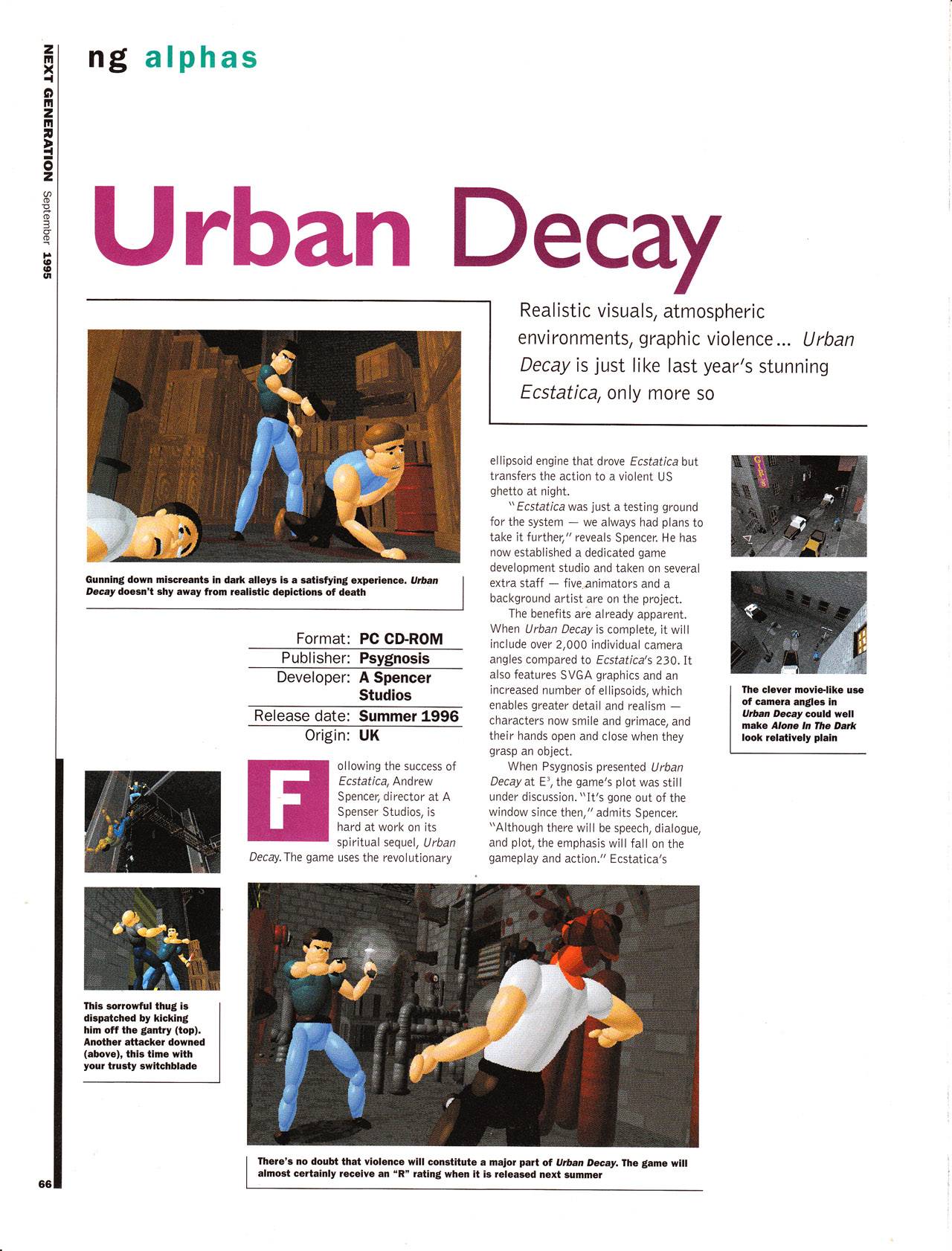
I was recently reminded of this excerpt from Next Generation magazine, posted on Hardcore Gaming 101's Twitter page a few weeks ago.


Note that Next Generation magazine was intended as an intelligent alternative to kid-friendly publications like GamePro and Nintendo Power. Note also how very far from intelligent the editors sound when they arrogantly dismiss shooter fans as "fogies" and use terms like "almost retarded" to describe the gameplay of G-Darius, regarded today as one of the high points of that series. This self-absorbed, technophilic propaganda was so common in Next Generation that one imagines the editors sniffing their own farts from wine goblets as they extol the virtues of cutting edge titles like, uh, Urban Decay.


"I didn't ASK to become the secretary of balloon
doggies! The balloon doggies DEMANDED it!"
(image from 4players.de)
I don't know where the writers of Next Generation are now... all the reviews in the magazine were written anonymously, demonstrating the foresight that the articles themselves lack. Wherever they may be, I'd like to inform them that the 2D games they worked so hard to kill have made a spectacular comeback, and cordially invite them to savor the fruit of my colon after a three course meal at the local Taco Hut.

Ah, that felt good. Speaking of Hardcore Gaming 101, I'd like to thank editor Kurt Kalata for telling me about Pharoah Rebirth+, one of the best indie games I've played in quite a while. Imagine Castlevania: Symphony of the Night, except set in Egypt and with seven stages instead of SOTN's massive playfield. And oh yeah, the hero is a rabbit with a pair of shape-shifting ears. The game was seven dollars during Steam's summer sale, but it's well worth the cost even at its usual asking price of ten. Also, it's in 2D, so it really ought to stick in the craw of whoever was writing those crap Next Generation reviews.

EDIT: It was actually HG101 contributor Federico Tiraboschi who wrote that Pharaoh Rebirth+ article, although it was technically Kurt who first told me about it. (Nice save, Jess. Heh.) 

Tuesday, June 28, 2016

A Master at Work

I like video games. I'm just not good at video games. Sure, I can hold my own against another mid-tier player in a versus fighter like Darkstalkers or Street Fighter Alpha, but I don't have the patience or the mad skillz to make it through something especially long and challenging.

I'll tell you, though, it's a lot of fun watching someone who does. Take this playthrough of the fiercely tough Sega arcade title Shinobi, for instance. YouTube user "Sub-Zero Lin Kuei" storms through the first two missions using close quarters combat against the mooks, and even has the nads to kick towering samurai Ken-Oh in the face! It's a beautiful thing. Shinobi used to regularly humiliate me when I was a teenager, but this guy has the game wrapped around his finger. Just... just watch.


The Master System version of Shinobi had a life bar, but Sub-Zero doesn't need one. He makes it through the playthrough without losing a life and with limited use of the "ninja magic" that scrubs the screen of foes. Heaven knows I was using it every chance I got.

So yeah, before I go, I should probably mention that there's a summer sale on PSN over the next two weeks. You can get dozens of games at steep discounts, including Street Fighter V, Grim Fandango Remastered, Mega Man Legends, and... uh... Monster Monpiece. (Don't get that.) It's a nice complement to Steam's summer picnic sale, and a hell of a lot better than what Microsoft is offering this week.

Saturday, June 25, 2016

A Glimpse of Greatness...?

You remember that Playstation 4? Well, I got it working, using a trick I found on the iFixit web site. It's one of those odd folk remedies that you can't believe actually works, yet it does... for maybe an hour. Then the system shuts right back off, possibly in the middle of a lengthy download. Evidently this is a common problem for this system, and without the cash to get it properly repaired I'm just going to have to live with it.

Then again, I could just play games on my PC, and with the Steam Summer sale in full swing it'd be a good time for it. Hundreds of games are currently discounted, and will remain so until July 4th, America's Independence Day (as opposed to June 24th, which is now Great Britain's "Oh God what have we DOOOONE?!" day). I'm personally thinking about Dark Souls, as it includes all the DLC content and with the right patch, offers higher quality torture than its Xbox 360 counterpart.

What else? Mighty No. 9, as predicted by pundits months ago, turned out kinda crappy. It's getting average ratings across the board, with reviewers claiming that the game feels half-hearted and unpolished. Hey, what did you expect for four million dollars? On the plus side... actually, I'm not feeling very plus side right now. I'd better stop for the day before I go full Morton's with my saltiness.

Friday, June 17, 2016

Live and Learn

Well, one would hope, anyway.

The Playstation 4 I bought on eBay, alas, appears to be a dud. There's no picture, no sound, and no access to the safe mode... just a blue light on the top of the system that strobes at an agonizingly sluggish pace. So unless I plan to host a rave party for sloths, it doesn't seem like I'll be getting much use out of it.

Go, sloths! Go sloths!
...uh, are you going, sloths?
(image from Pinterest)
Outwardly, I'm frustrated that I may have flushed a hundred dollars (plus shipping!) down the crapper. This PS4 was bought as-is with no returns accepted, and it may not be feasible to get it fixed. My options are to either take it to a repair shop in Tucson or ship it to Sony, and either will likely double the initial investment. I've been able to buy busted systems and revive them in the past, but I'm not confident I'll be able to bring this one back to life. It's kind of a downer, walking past that Playstation every day and knowing that it may never be anything more than a rhomboid paperweight.

Deep down inside, however, I'm not that choked up about this. Back in 2006, I was eager to step up to the big leagues of the Xbox 360, but ten years later, buying a current generation console feels like an obligation; something I HAD to do to continue enjoying the hobby, rather than a choice I was happy to make. 

Admittedly, software for the Playstation 4 and Xbox One is getting better... we're starting to see fewer rehashes of last generation games and more titles designed especially for the new systems. I'm especially excited about Horizon Zero Dawn, an upcoming action-adventure title that likely would have been held back by the ten year old technology of the Xbox 360 and Playstation 3. Here's a clip of the game's robot-slaying warrior princess in action, in case you missed the reveal at E3:


Yeah, I'd like to play that. But it's probably not going to be out until next year, and I wouldn't have much to tide me over while I waited. There's not a lot on the Playstation 4 that thrills me at the moment... just Street Fighter V (once it's finished, cough) and a handful of indie titles which could just as easily been released for the Playstation 3. Many of these are already available on personal computers, and a few can be played on the significantly cheaper Playstation TV.

Then there's this push toward iterative consoles. If I bought a working Playstation 4, how long is it going to be before I'm nudged into purchasing the next Playstation, and the Playstation after that? If last week's E3 was any indication, maybe a couple of years at best. I've had friends argue that frequent hardware refreshes could benefit early adopters, in the same way that the owner of an older PC or Android phone can still run the majority of software available for those formats. I just wish I could be that optimistic.

The S stands for "sucker."
(image from Microsoft)
Game consoles aren't phones, and they're not personal computers. They're closed source platforms, and competition is limited to three manufacturers, rather than dozens. Yes, Microsoft and Sony are claiming now that you won't need the Playstation Neo or the Xbox Scorpio to remain in the two companies' ecosystems, but details about these high-powered consoles are both elusive and subject to change at any moment. Sony claims the Neo will complement the Playstation 4 rather than replace it, but this suggests separate software libraries for the separate product lines. Microsoft is months from launching a redesigned Xbox One that's smaller and more powerful than the original. That's not even the Scorpio, but a second model of its flagship console with just enough benefits to make owners of the first feel profoundly foolish about their purchase.

Sony and Microsoft are insisting otherwise (for now...) but when the new consoles arrive, who's to say the two companies won't shift the focus to their new products, at the expense of the old ones? Who's to say developers won't take advantage of the advanced technology of the Xbox Scorpio and Playstation Neo, while releasing inferior versions of the same product for the legacy consoles? It's the way the industry has always worked in the past... there's no reason to believe things will be any different now. If Sony and Microsoft have new consoles, you'd better believe they'll find ways to incentivize a purchase.

So yeah, I feel a little stupid for having bought that Playstation 4. Not just because it didn't work, but because I don't think I'm ready for one that does. Or the systems that will be nipping at its heels.

Monday, June 13, 2016

The Digital Dilemma

I try to keep this blog focused on video games, but what happened in Orlando this weekend is incredibly hard to ignore. After a shooter's rampage in a gay nightclub, there are fifty people dead, fifty people bleeding, and at least that many politicians offering phony "thoughts and prayers" when they should be doing their jobs. I'd like to say I expect better from this country, but the fact that I don't honestly believe this is intensely worrying.

If you want to help (and I mean actually help, unlike the aforementioned politicians), you can do that by clicking this link and giving some much-needed money to the survivors of this needless, yet all too familiar tragedy. Thanks.


So yeah, video games. It's not a subject that's first and foremost on my mind, but there was something I've been wanting to discuss for a few days. In the early days of Wheel of Fortune, host Pat Sajak frequently reminded contestants that "once you buy a prize, it's yours to keep." It was a catchphrase that stuck with me long after Wheel abandoned its showcases filled with tacky ceramic dalmatians and Spiegel gift certificates. If you can't keep something and hold it in your hands, why even pretend that you own it?

This mentality left me reluctant to embrace digital distribution, but over a decade after the launch of the Xbox 360 and Steam, I'm starting to come around. What digital distribution lacks in permanence, it more than makes up for in convenience, as illustrated by my move to Arizona a couple of years ago. When I climbed aboard that plane headed for Tucson, there was only so much of my physical collection I could take with me, but all the games I bought on Xbox Live, PSN, and Nintendo's eShop took up no space in my luggage. Having a digital collection meant dozens of my games were available wherever I went, without actually being there.

There's another benefit to buying digitally... once you buy a prize it really is yours to keep. I can't count the number of times I've sold games in my physical collection to stretch my budget, but that's never a temptation with digital because you only own the license, and that can't be transferred to anyone else. Couple that with weekly online sales which drastically undercut retail prices and you've got a way to build a massive library of games that's always at your fingertips.

Well, maybe always. Digital libraries are still relatively new, and nobody knows for sure where their collections will be in the future. When console manufacturers like Sony and Microsoft abandon their old hardware, will players still be able to access the games they've purchased, or will all that software be lost once the servers are shut down? It's a question that's left older players, especially preservationists, on edge. They own cartridge-based games that date back to the '70s and '80s. Will their digital libraries stand the test of time as well? With Sony abandoning backward compatibility and adopting a streaming subscription service to take its place, it's hard to be optimistic about the answer.

So I might come to regret it later, but for now, I'm happy buying my games digitally. Hey, it keeps me from having to get off the couch to swap discs.