Saturday, June 21, 2014

Vital Signs: The PS Vita Review

So, let's talk Vita, shall we? I picked up Sony's latest handheld for a song a couple weeks ago and I'm eager to give it a ten-point inspection.

THE LOOK


Meet a Vita.
(image courtesy of Amazon)
At first glance, the PS Vita looks very much like its predecessor, slightly larger but with the same widened oval shape. However, a few things jump out at you on closer inspection... two tilting analog sticks have replaced the single sliding pad of the PSP, there's a tiny camera embedded next to the Playstation's familiar rosette of action buttons, and you'll find a recessed button emblazoned with the Playstation logo on the bottom left of the system. Turn the Vita around and you'll find another camera, along with a long flat panel replacing the PSP's chrome circle.

While you're holding the Vita, one other difference becomes obvious. Reviewers often called the PSP "sexy" when it debuted in 2005, but nearly a decade later, the system seems far less elegant, with sharp edges and a thick, heavy frame. The Vita is more comfortable to hold, with rounded edges and grips molded into the back. It may not be the most hand-friendly handheld I've ever owned (for all the system's issues, the rubberized shell of the Gizmondo felt heavenly), but it's up there.

THE MUSCLE


Not quite ready for prime-time.
Sony claims that the Vita puts console-quality gaming in your pocket. If that sounds like a familiar boast, it should... it's the same claim they made with the PSP nearly ten years ago. Some Vita games make good on that tall promise- Flower looks gorgeous with its colorful petals and lush grass blowing in the breeze- while others fall short of the mark. Mortal Kombat's visuals are noticeably downscaled from the console versions, with muddy textures and sharp polygonal edges in close-ups.

Console-quality or not, the Vita is a huge improvement over both the PSP and the 3DS where raw horsepower is concerned. The system sports a quad-core ARM processor running at 1 GHz and its own dedicated graphics processor, which can display up to 133 million polygons per second. The PSP could only manage 33 million polys per second, while the 3DS limps along with just 15 million polys. The gap in visual quality is not so evident on the relatively small screens of the Vita and 3DS, but you'll definitely notice the faster processor in the Vita when you're starting and switching apps. It takes about five seconds to start the Vita's social gaming app near... for the 3DS's Street Pass Mii Plaza, it's closer to seventeen.

THE MEMORY


From left to right: PS Vita memory card (and
Micro SD card beneath it), Memory Stick Pro
Duo adapter, PSVita game cartridge,
standard SD card.
Early models of the Vita have no internal storage, while later ones offer a measly one gigabyte of storage. You'll most likely have to purchase a memory card to store games and media. This probably isn't a surprise coming from Sony, but unlike the Memory Sticks of the past, the Vita's proprietary memory cards are designed only for the Vita and cannot be directly accessed from a computer. It's infuriating, but it's not hard to figure out why the system is so tightly locked down when you consider how open Sony's last handheld was to hacking and piracy.

Vita memory cards come in sizes ranging from four gigabytes to a kingly sixty-four gigabytes. The four gigabyte card was recently discontinued, and it's not hard to figure out why. It's just barely enough storage to scrape by, with room for one Vita, PSP, and PSOne game. More dedicated players will want at least a 16GB card, but at $40, that storage doesn't come cheap. A 32GB card costs a hair-raising $60, and a 64GB card... well, if you have to ask, you can't afford it.


Please sir, can I have some manual?
Alternately, you can kick it old-school and just buy your games on cartridge. Cartridges are roughly the size of a standard SD card and fit into a slot at the top of the system, conveniently labeled "PSVITA." Once you pop a cart into your system, an icon appears on the desktop and bounces excitedly until you tap on it. That icon remains even after you've taken the cartridge out of your Vita, a strange and slightly aggravating side effect of the way the system handles game saves. I made the mistake of assuming that the used Vita I purchased was packed with games, until I came to the bitter realization that all those icons were merely game saves.

By the way, Vita games don't come with instruction booklets. This usually isn't a problem, but it took a lengthy online search to find out how to silence the bedeviled caddy in Hot Shots Golf: World Invitational. So usually, but not always.

(You press start while you're playing, then select Options from the menu that appears, then go to Caddy Voice and pick Off. There, I just saved your sanity.)

THE STYLE

The simple but effective Cross Media Bar from previous Playstation systems has been replaced with a new interface designed especially for the Vita's touchscreen. Circular icons are arranged on the screen in a honeycomb pattern, and can be either tapped directly with a finger or selected with the D-pad or left analog stick. The interface is an awkward halfway point between the ones in traditional game consoles and smartphones, and doesn't make the best use of the Vita's display. The staggered icons waste a lot of onscreen real estate, and they're neither practical nor attractive, resembling Mentos with their narrow edges and fat centers.

Quick, peel, peel!
Fortunately, the interface redeems itself with a bizarre yet brilliant way to manage apps. Pressing the home button on the bottom left of the screen pauses an app you're running, with a dog eared corner of a page appearing on the top right. From here, you can either flip through the active apps or peel away the dog ear to close the app you've selected. The lock screen works in the same way... once you've taken the system out of sleep mode, you just tug at the dog ear to resume whatever you were doing before the Vita took a nap. It comes naturally pretty quickly, and you'll wish you had the option in other devices.

THE FEEL


The best thing to ever happen to a
Sony game system. (Aside from Bernie
Stolar leaving to join Sega, I mean.)
Plenty of control options are available on the Vita, including a newly designed D-pad that's easily the best Sony has ever made. Like the controllers for the Sega Saturn, the D-pad rocks on a central pivot, and the four directionals are no longer separated in the middle as they were in past Playstation systems. The end result is the most fighting-friendly handheld since the Neo-Geo Pocket. Special attacks in games like Mortal Kombat and Darkstalkers Chronicle flow off the thumb and onto the screen with little effort, a far cry from the stubborn separated cross on the PSP.

The analog sticks are an improvement over the sliding pad on the PSP as well; easier to grip with the thumbs and more sure of their positions than the slightly mushy cycloid. On the downside, the action buttons are needlessly small, and the option keys (Start and Select) are not only tiny, but flush with the unit. If you need to pause your game for any reason, you'd probably be better off using the Home button, or even tapping the on-off button on the top of the Vita to put it to sleep.

Oh yes, about that on-off button! The silvery circle is far more user-friendly than the finger-shredding switch on the PSP. Just tap it and your Vita enters sleep mode. Tap it again (or just press the home button... that thing is handy) and the system snaps back to attention. Want to turn off the system completely? Hold the on-off button until a prompt appears, then tap the orange bar on the screen. It's beautifully simple, the exact opposite of the PSP's accursed power switch.


What is this I don't even...?
Finally, there's the touchscreen, the twin cameras, and curiously, the back touchpad. The touchscreen works as it does on the 3DS, smartphones, and tablets, letting you select onscreen options with a single tap. It's generally more responsive than the 3DS touchscreen and can recognize two fingers at once, letting you pinch and stretch web pages in the browser built into the Vita. However, you'll need to use your fingers rather than a stylus, which may be an issue for the small handful of games that use the touchscreen creatively. The twin cameras take video and snapshots at 640x480 resolution, and it's clear after your first picture that they were included as an afterthought. Grainy, washed-out images are the norm, although they might work in a pinch for the system's optional Skype app. Finally, there's the touchpad, which seems more like a product of mindless oneupsmanship than a feature designed for practicality's sake. Some games make a valiant attempt to justify its existence (the system's star attraction, Tearaway, lets you use it to poke your fingers through the screen) while others just use it as the L2 and R2 buttons it probably should have had in the first place.

THE VIEW


A comparison of the screens on the PSP
(top) and the PS Vita (bottom).
Aside from the high performance hardware, the Vita's headline feature is its large OLED screen (replaced in recent models by a just as large, but less impressive LCD screen). At five inches diagonally and with an impressive resolution of 960x544, the Vita's screen is indeed luxurious by the standards of handheld game systems, and the OLED technology really makes oranges and reds sizzle, without the white haze of a backlight. On the other hand, OLED screens are expensive and fragile. If you drop your system, it will probably break... and it will probably cost a whole lot of money to replace. Keep that in mind before you buy one of the older Vitas.

THE POWER

Like other post-Game Boy handhelds, the Vita squeezes about four hours of life from a full charge of its internal battery. That time is cut in half if you're using online features like the Playstation Store. On the flip side of the coin, putting the Vita in sleep mode uses almost no power at all. There have been reports that the system can be put to sleep for weeks at a time with barely any drain on the battery, so if you plan to use the Vita with any frequency, you probably won't want to shut it off at all.

THE ACTION


Hey, that weird-looking face in the sun is MINE,
you papercraft putz!
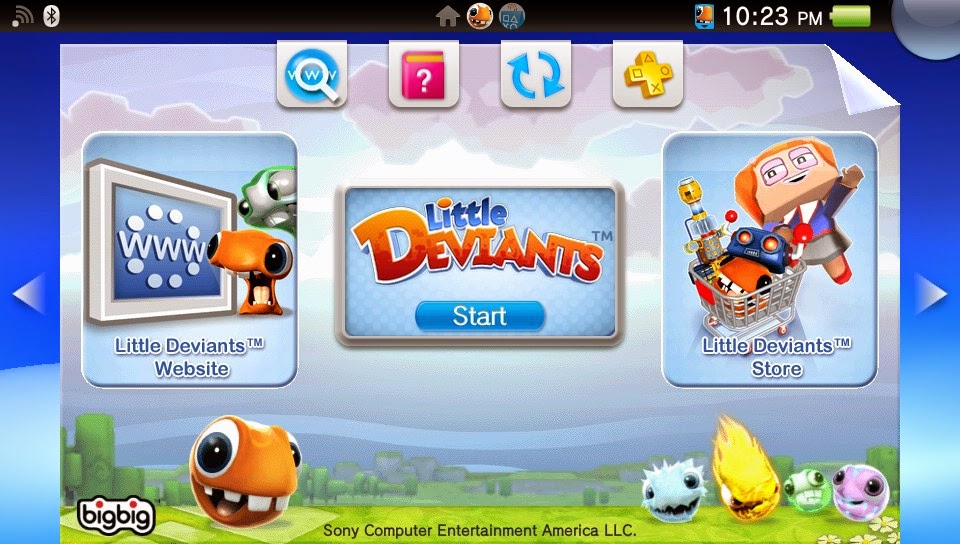
I'll review a handful of Vita games in a future blog entry. For the moment, I'll just say that I've been mostly satisfied with the software I've played so far. Tearaway in particular is hugely endearing, taking full advantage of the Vita's features (even the ones it didn't really need!) and offering a world that could have been peeled from an episode of Pee-Wee's Playhouse. It's the kind of game Shigeru Miyamoto would make if he were working for Sony. (And wasn't counting the days 'till his retirement.) Little Deviants has been the biggest dud of the bunch, a barely disguised tech demo of the Vita and its front and back touch panels. It's not just that the game is dreadfully average... it's that its stars are so obnoxious you'll want to reach into the Vita to smack the people who designed them upside the head.

Compared to the 3DS, well, the two systems don't compare, really. They're different experiences, just as the DS and PSP were, and I wouldn't want to sacrifice one for the other. I personally think the 3DS has the best games overall, but there have been times that I wish the system had everything the Vita offers, like dual analog thumbsticks and shoulder buttons that actually do things when you press them. (Glares angrily at Kid Icarus: Uprising) The Vita is also the better choice if you're looking for multimedia features, because its large screen and loud speakers are better suited to music and movie playback than the 3DS.

THE INTERACTION


So near, and yet so far away...
(image courtesy of Powet.tv)
Here's where the Vita falters. Most models use Wi-Fi to access the internet, while others have 3G to ensure online connectivity everywhere. I've got one of the Wi-Fi models, and have found that its online features have been dicey at best. The social gaming app near wouldn't work at all until I used the system in a large college town, and even when it did, it only displayed the locations of a handful of Vita owners and the games they were playing. It's not nearly as entertaining as Street Pass, which encourages players to seek each other out for puzzle pieces and helpful items in compatible games.

Getting the system's other online features to function has been a struggle. I couldn't get the E-mail app to accept my Gmail address; I kept getting time out errors. It doesn't seem possible to view my friends list through PSN, and downloading games through the Playstation Store has only worked intermittently and is painfully slow. Granted, I live out in the boonies and my internet is far from ideal, but my 3DS works well enough with those limitations... what's the Vita's problem?

THE VERDICT

The Playstation Vita is worth owning if you know what you're getting- what you're really getting, not what Sony promised when it launched- and if you're comfortable with the price. I paid seventy five dollars for mine, but I realize that others paid double or even triple that price. For the two hundred dollars it costs at retail, the Vita is a lot harder to recommend. If you want a console-quality gaming experience, you might want to just take those two C-notes and buy a console.

(Special thanks to IGN, Wikipedia, and Gizmag for confirmation on technical specifications and stuff.)

Saturday, June 14, 2014

Your Show of Shows: A Brief, Biased E3 Recap

Why do 90% of today's games look like they
were designed by Beavis and Butthead?
(image from SegmentNext.com)
I'll be honest with you guys... I wanted to cover the Electronic Entertainment Expo, but I found my mind wandering during much of the coverage on Twitch. Far too much of what was shown was, to quote a reader of Huffington Post's UK branch, "grey and miserable." I literally got angry after watching gameplay footage of Far Cry "Who Gives a" 4 and the teaser clip for Dead Island 2: You'll Fight More Zombies and LIKE It. More Assassin's Creed games are also on the way, and while I like the series, I think the Madden approach of releasing at least one game a year is threatening to strip the luster from the series. I haven't even played Black Flag yet! Do we really need more of these so soon?


The colors, Duke! The COLORS!
(image from GamerZona.com)
Luckily, Nintendo came to the rescue late in the show with a handful of great games for the Wii U. I had doubts about purchasing the system in January, but believe me, those doubts no longer exist. Splatoon is the antithesis of every brown-grey shooter planned for the Xbox One and Playstation 4, with elfin tweens spraying each other and their surroundings with paint. You can explore each stage on foot, but it's faster and sneakier to transform into a squid and swim through the paint you've laid down. It's familiar PvP gameplay served with a fresh Nintendo twist, and it's got the potential to keep gamers glued to their Wii Us after they've lost interest in Mario Kart 8.


And speaking of Captain N...
(image from Gamershell.com)
The latest Super Smash Bros. is packed with promise as well. With Pac-Man added to the cast, it's got more famous video game heroes than an entire season of Captain N: The Video Master, and there's even an option to send your Mii (essentially a Fisher Price version of yourself) into battle, complete with a customized move set. I've never been able to get a feel for the Smash Bros. games, but the more personalized experience in this one makes it tempting to give the franchise another shot.

What else? There's Captain Toad's Treasure Tracker, with the hapless mushroom retainer collecting gems in small, sadistically designed environments. Since Toad can't jump, you'll have to move sections of the stage around with your stylus to clear his path and guide him to victory. Then there's Yoshi's Woolly World, which gives the green dinosaur an arts and crafts makeover, and Kirby's Rainbow Curse, a revival of the DS game where the pink puffball rode on lines drawn by the player, and Mario Maker, which lets you design your own Super Mario Bros. stages, and the bat guano-crazy Bayonetta 2, and a Legend of Zelda game with a vast, fully explorable Hyrule, and, and...!

There's a lot of stuff planned for the Wii U, let's just put it that way. Two years after the Saturn was released in the United States, Sega abandoned the system, claiming that it had no future and that further support would be pointless. Two years after the Wii U's troubled debut, Nintendo is shouting "damn the torpedoes!" and fighting valiantly to keep the system afloat. Kudos to them for this... not every company is so eager to reward the loyalty of a small but vocal fanbase.

All right, enough of that. I recently bought a Playstation Vita and plan to review that right here, as soon as I've gotten familiar with it. Stay tuned!

Tuesday, June 3, 2014

Thanks but No Thanks: Disabling Alerts on the Wii U's Quick Start Menu

Nintendo recently updated its Wii U, including a quick start menu that lets you play games just seconds after you've started the system. That's the good part. Now here's the bad part... by default, the Quick Start Menu will also turn on your Wii U's gamepad to alert you of exciting new offers by Nintendo and its partners. (In other words, bullshit advertising.) Thanks, Nintendo, you shouldn't have.

No, really, you shouldn't have done this.

Anyway, since people have asked, here's a step by step guide to turning off this unwelcome feature and keeping your household from turning into the mall scene from Minority Report.


1. Turn on your system (so far, so good!).


2. Tap the wrench (System Settings) in the Quick Start Menu.
You can also do this in the standard Wii menu if you'd prefer. 


3. Tap the wrench and on/off button (Power Settings) at
the bottom of the System Settings menu.


4. Tap the large icon that appears in the center left
of the screen.


5. Tap the "Quick Start Menu" button in Power Settings.


6. Tap the "Wii U GamePad Alerts" button. (You can
also turn off the Quick Start Menu entirely if you
want quick access to your system's legacy Wii
features.)


7. Tap the "No" button. With reckless abandon.


8. Your Wii U is now free of intrusive, annoying
ads, the way nature intended!


9. Show Nintendo what you think of this new feature.

If this guide was useful, spread it around! I could always use the hits.

Monday, June 2, 2014

Tonight, on Wings! (Kid Icarus and four Super NES finds)

I just watched an episode of Kill La Kill. Boy, that sure was an anime. It sure was...

Anyway! I thought I'd bring a few things to your attention. Firsties, Yumi's Odd Odyssey, the very first Umihara Kawase game to hit the United States, is now just twenty dollars on Nintendo's eShop. You'd better bite quickly, though, because the price will shoot back up to its usual thirty clams after June 15th. Thanks to the always awesome Tiny Cartridge for that news.


Your eyes in the sky.
(image provided by The Guardian)
Speaking of the 3DS, I snagged a copy of Kid Icarus Uprising on clearance from K(rap)-Mart a few days ago. Reviewers have made a fuss about the awkward control, and it is a bit of a kludge, but I can still say without a moment's hesitation that it's a hundred times better and more polished than the original game on the NES. Frankly, you'd have a hard time noticing the family resemblance if it weren't for the familiar characters, including an older, more likeable Pit. Rather than a confused platformer with an instantly fatal bottomless pit swallowing up the scenery (GRR!), Kid Icarus Uprising is split evenly between on-rails shooting (think Panzer Dragoon but without all the welts from the ugly stick) and a free-roaming action game with ranged and melee attacks. The closest comparison I could make is to Treasure's oft-ignored Sin and Punishment series, but even that's not quite accurate because you've got a lot more control over where Pit goes after he lands. 

One thing I can say with confidence is that the game is the prettiest thing you're likely to find on the 3DS. The aerial scenes bring back fond memories of the panoramic skylines in the laserdisc game M.A.C.H. 3, except these are rendered in real time. And on a handheld, no less! I haven't played much of Uprising yet, but what I've seen so far has me thinking that twenty bucks was well-spent.

Okay, there's one other thing before I go. I managed to find four Super NES games at a local pawn shop. Only one of them was valuable from a collector's standpoint, but they're all precious to me because 16-bit games without chubby sportscasters on the front have gotten incredibly tough to find. Here now for your reading pleasure are brief reviews of all four of these titles...

SUPER PINBALL: BEHIND THE MASK


You shall buy this stationary plastic
demon, or I will curse thee to the end
of time!
Released later in the life of the Super NES but nevertheless worth about a handful of magic beans online, Super Pinball is the first in KAZe's series of slavishly realistic pinball simulations. Don't expect dragons or aliens to come to life here... Super Pinball is according to Hoyle all the way, with authentic ball physics, an angled perspective, and a simulated LED display. There are three tables available, with Wizard being the most attractive and entertaining of the lot. However, no matter how you play it, Super Pinball is pretty dull next to more adventurous pinball games like Devil's Crush. It's also hobbled by the relatively low resolution of the Super NES, a situation that would later be rectified in the sequels on the Sega Saturn. Digital Pinball: Necronomicon in particular used a special, often neglected high-res mode, making the graphics incredibly sharp compared to other Saturn games.

JOE AND MAC


T-Wrecked.
There's so much nostalgia attached to this one! I used to play it at a bowling alley with a similarly game-obsessed friend, then played it at his house when the Super NES was launched in the United States. However, when you strip away those fond memories and some beautiful, vibrantly colored visuals, and Joe and Mac is just an ordinary platformer with a prehistoric setting. You collect stone-aged weapons, ride pterodactyls, and club screen-filling, meat-eating dinosaurs into submission, all while hoping nobody notices the anachronism of ancient man living with creatures from the Jurassic period. A teensy bit of depth was added in the form of a world map and bonus stages, but past that it's the same brainless action game you dropped quarters into at the arcade. There was also a Genesis version which was technically more faithful to the original, but you should probably skip it, unless you like the thought of punching a hole through a concrete wall because the game dragged you back to a checkpoint for the seventeenth time.

MORTAL KOMBAT 3


You're gonna need a much bigger
explosion to stop Jax.
This game is tied to one of my greatest regrets as a collector. Years ago, a neighbor was selling their Super NES and a handful of games for around twenty dollars. Their collection included the Donkey Kong Country trilogy and several fighters, including this one. Guess who passed on the sale of the century because he already had a Super NES and didn't like Donkey Kong Country? Yep, this dope right here. I just hope the guy smart enough to jump on this deal is having a grand old time with his bounty. (Hmf.)

Well, I did finally get Mortal Kombat 3, at least. A few months ago, I reviewed the Genesis version of this game, warning readers that the Super NES was better suited to its unique brand of digitized carnage. Playing this reinforces that opinion, but I've also noticed that Mortal Kombat 3 isn't just better on Nintendo's machine; it's harder. Even on the lowest difficulty setting and when choosing the "novice" ladder, the CPU managed to thoroughly humiliate me by the second stage. Er, maybe I should find something that's a little more my speed...

MIGHTY MORPHIN' POWER RANGERS: THE FIGHTING EDITION


It's much more fun to blow
up
the Lip Syncher. You're
going back to Funkytown, baby!
...and here it is! Mighty Morphin' Power Rangers: The Fighting Edition is, as the title clearly states, a versus fighting game with the cast of everyone's favorite spandex-clad superheroes. Except you're not playing as the Power Rangers themselves, but rather their Zords, towering robots built from slightly less enormous animal-droids. Alternately, you can play as the Lip Syncher, who looks like a background singer from a Robert Palmer video after a terrible cosmetics accident, but who'd want to do that?

The massive scale of the characters aside, MMPR isn't too much different from the dozens of games on the Super NES hoping to capitalize on Street Fighter II's success. However, the graphics and sound are so incredible, you may not care. The Zords are every bit as massive as they are on the show, and bursting with color and detail. A little research reveals why... the game was ghost-written by Natsume, one of the Super NES's most consistently brilliant third-party developers. The engine built for MMPR would eventually be used as the foundation for Gundam Wing: Endless Duel, a much-improved mech battle game released only in Japan.


Forget the teenagers with attitude;
maybe you ought to recruit some
fitness trainers.
There's one other thing worth mentioning... the power gauge in MMPR: The Fighting Edition is some kind of nuts. It fills (and empties) on its own, and you'll have to time your special moves perfectly to take advantage of it. If you manage to pull off a special when the meter is at its max, the gauge changes color... do it a couple more times and the bar crackles with energy, letting you scrap your opponent with a devastating super move. I can't think of another fighting game that does this, and although I totally understand why other fighting games wouldn't want to do this, Natsume gets a lot of credit for taking that risk and trying something new.

Friday, May 30, 2014

Something's Fishy: The Snow Bros. Localization

The Gay Gamer's Bryan Ochalla recently reviewed a quartet of games for the original black and white GameBoy, including the handheld port of one of my personal favorites, Snow Bros. For those of you who missed it, Snow Bros. is an arcade title released by Toaplan in the early 1990s, and likely the best Bubble Bobble game not actually named Bubble Bobble. As the name suggests, Snow Bros. gives the familiar fixed screen gameplay a chilly twist. As pudgy snowmen Nick and Tom, you'll first pack enemies (which often bear an eerie resemblance to a Muppet Al Molinaro) in massive snowballs, then send them rolling across the screen into other nasties. Nailing all the creatures with a single snowball is immensely difficult but hugely rewarding, earning you a feast in sushi.

Well, it does in Japan, anyway. The arcade version of Snow Bros. and its incredibly faithful Genesis counterpart (released only in that country and Europe) still let Nick and Tom nosh on tuna rolls and temaki. However, when Capcom released the game in the United States for the NES and GameBoy, the raw fish and seaweed were changed into something more palatable to an American audience. Observe!


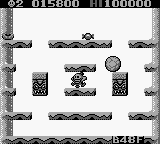
On the left is the original Japanese version of Snow Bros. Jr., designed by the mysterious Naxat Soft. You'll notice a hand roll to the left of the monkey, and assorted bits of sushi just above him. On the right is the American version of the game, localized by Capcom. Near the top of the screen are two new prizes, a doughnut and a piece of hard candy. 


There's one other difference in the US version of the game that's worth mentioning. Both titles have a password that appears on the bottom right corner of the screen. However, the American version of the game gives that password its own screen, stuck between stages. The Japanese version of Snow Bros. Jr. just scrolls the old stage off the screen once you've cleared it of enemies, much like the arcade game did. I guess I understand the purpose of the password screen, but just between you, me, and the Internet, I think it's jarring and unnecessary, putting the brakes on an already sluggish port.


Here's a similar comparison on Nintendo's 8-bit console. On the left side is the Famicom version of Snow Bros., with sushi as the bonus prizes. On the right, the NES version, with a lollipop. The change isn't significant enough to make this competent conversion any less fun to play, but it does lose a little of its original, uh, flavor.


Just for the sake of self-indulgence, here's a picture from the Genesis version of Snow Bros. Although not quite up to par with the arcade game visually, its improvements over the NES and especially the Game Boy versions are not insignificant!

Friday, May 16, 2014

Your Better Half: Persona 3 Portable

I mentioned Shin Megami Tensei in a couple of other posts, but I've never really sat down and played one of the games in the series. I mean one of the real games, not spin-offs like Raidou Kuzunoha vs. Whatever Creepy Thing He's Fighting or Persona 4 Arena or that silly platformer on the Virtual Boy. Recently, I decided that it was about time that changed, and picked up a copy of Persona 3 Portable, offered for five dollars along with a handful of other Atlus games in a recent PSN sale.

That was a wise investment.

Gosh, that'd be swell! You think we could go
steady? Maybe we could hang out at the
malt shop and get an egg creme...
(Image courtesy of Games-Open.com)
To be honest, I wasn't convinced of that at first. After an introductory sequence with teenagers sticking guns to their heads (and I'll talk about this later in the post, because it warrants further discussion), I was treated to a visual novel about some high school student's dull adventures on and off campus. You sit through lectures by self-absorbed teachers, listen to idle gossip from other students ("Ooh, senpai is so dreamy!" Oh, shut up...), and hang out at the mall. It's not exactly a white-knuckle thrill ride.

However, a funny thing happens a couple of hours after the game begins. You discover that there's a mysterious time just after midnight (no, not Fourth Meal), when dangerous shadows roam the city and most of the populace sleeps peacefully in coffins. You're one of the "lucky" ones who remains awake during the Dark Hour, which means it's your job to hunt down the creatures of the night with the aid of a ghostly partner called a Persona.


The combat system from the expanded
Playstation 2 version, Persona 3: FES.
(Image from ugnnultragamingnewsnetwork.com)
When the clock strikes twelve, the game leaves its high school baggage behind and becomes a Rogue-like, in the grand tradition of Gateway to Apshai, Fatal Labyrinth, and countless other dungeon crawlers. You and two similarly gifted friend climb the massive tower Tartarus, slaying shadows, discovering handy items inside suitcases, and ultimately finding the stairs leading to the next floor.

Enemies roam the tower, which you can either avoid or challenge in turn-based battles. You can sometimes take out your inky adversaries with ordinary attacks, but when swords and arrows can't do the job, you'll need a helping hand from your Persona. Just stick a gun to your temple and pull the trigger (really, I will cover this later) and an avenging spirit swoops down to make short work of your enemies. If you score a critical hit, you may even be able to team up with your friends for a cartoonish three-way smackdown, complete with dust clouds and enough onomatopoeia for a season of the old Batman television show.

As you'd expect, beating enemies earns your three ghost-busting teens experience points, which strengthen their abilities. However, you may also earn a tarot card which makes your Persona stronger, or an entirely new Persona which you can fuse with other spirits for a powerful hybrid. It's an involved process, and you'll likely be throwing together Personae in the Velvet Room for hours until you've discovered all one hundred and forty of them.


I... just don't see the need for this.
(Image courtesy of BlogCritics.org)
Okay, I said I was going to come back to this at least two times already, so here goes. Persona 3 Portable is packed with imagery of teenagers pressing a gun to their foreheads and pulling the trigger, complete with neon polygons spraying out of the exit wound. This is, to borrow a phrase from about a million junior activists on Tumblr, gross. The developers tried to justify this by claiming the simulated suicides force the player to recognize the gravity of calling out their Personas. However, I suspect the game's young heroes would barely flinch after not-really blowing their brains out for the hundredth time, leading me to ask (again) if the oft-repeated imagery was really necessary. After all, Jotaro Kujo and his friends summoned their Stands just fine without fellating a firearm first. 

Even with that unwelcome touch and graphics that are starting to show the PSP's age, Persona 3 Portable is a great way to while away the dark hours of your own day. At five dollars, it's hard to resist, even if you're not especially eager to relive the high school drama of your teen years.

Tuesday, May 13, 2014

Kinect Bites, The Dust

This one's going to be brief, since the content within is time-sensitive. First, Microsoft has backpedaled on the design of the Xbox One (again), offering the system without its annoyingly intrusive Kinect camera for $399. The company also revealed in its recent press release that multimedia apps like Netflix will no longer require a subscription to Xbox Live Gold. (Absolutely nobody else was doing this; it's puzzling that it took this long for Microsoft to hop aboard the clue train.) Finally, the Games with Gold promotion will extend to the Xbox One in the near future, and there will be three freebies offered for the Xbox 360 next month, including medieval emasculator Dark Souls and upgrade-to-the-upgrade Super Street Fighter IV: Arcade Edition. If this is Microsoft's apology for last year's disastrous Xbox One unveiling... well, they'll still have to sleep on the couch, but it's a good start.

Speaking of Games with Gold, Dust: An Elysian Tail is currently up for grabs for Gold subscribers, and if you have any love for Muramasa or its spiritual predecessor Odin Sphere, I'd suggest you snap up a copy while the snappin's good. Designed almost entirely by Korean-American artist Dean "for the last time, I'm not a Pokemon!" Dodrill, Dust is a sprawling action game in the tradition of Metroid and later Castlevania titles. I've actually owned the game for a while, but was inspired to return it after a year-long hiatus when Apricot Sushi declared May the month of Metrovanias. Smart move! Dust is absolutely gorgeous, and offers an equal blend of crisply responsive platforming and button-mashing combat, topped with a dollop of likeable (if frequently silly) characters. Yes, they're furry, but after the excellence of Tail Concerto and Solatorobo, I hope you wouldn't turn your nose up at a game just because it has a few talking dogs and rabbits in it. Dust is free for just a couple more days, so get to it, people!