Friday, February 14, 2014

Penny Squeezins: My Latest, Cheapest Game Purchases

Good golly Miss Molly, I was supposed to be updating this blog! A thousand apologies, folks. My early impressions of the Wii U haven't been fully fleshed out and my top forty list of Genesis games has hit an Earthworm Jim-shaped roadblock, so how 'bout some brief reviews of the games I've bought (for stupidly low prices) over the last couple of weeks? Maybe I'll throw in my thoughts on the recent Nintendo Direct presentation as a bonus.

CRAZY TAXI
Android (played on Nexus 7 2013 edition)
Price: 99 cents


Oh, you'll miss plenty with control like this.
(image courtesy of Jeuxcapt.com)
What's most amazing about the Android format is how a tiny phone can offer everything you love about the home console experience. Well, everything but the fun, anyway. This port of the Dreamcast favorite Crazy Taxi is just one example, looking and sounding very much like the real thing but quickly running out of gas thanks to its awkward touchscreen control. You can also play the game by tilting your Android device like a steering wheel, but neither option compares to an analog thumbstick, and you won't be able to use one on 'droid unless you're willing to root your system and jump through a whole lot of hoops.

The predictably lackluster control makes Crazy Taxi a largely hands-off experience. Nevertheless, you'll be surprised by how faithful it is to the Dreamcast game while you're kind-of sort-of playing it. Music by The Offspring and Bad Religion blasts in the background as you tear through the city, picking up passengers and taking them to such iconic locales as, uh, Pizza Parlor and the Fried Chicken Shack. Even without the official license, it's not hard to figure out what that red roofed restaurant is supposed to be... not that Pizza Huts even look like that anymore. Remember, Crazy Taxi was released nearly fifteen years ago! (Why yes, you are old.)

By the way, there's a rumor floating around on the internet that Sega was able to survive its many dumb mistakes because it patented the navigation arrow and fleeing bystanders in this game. Thanks to the popularity of sandbox games and the necessity for a navigation arrow in their massive worlds, Sega gets a steady stream of profit from video game sales, even when those games aren't their own.

LEGEND OF ZELDA: A LINK BETWEEN WORLDS
Nintendo 3DS
Price: $15


I scored a digital copy of this game from a member of Cheap Ass Gamer, the internet's foremost pincher of gaming pennies. Normally, I wouldn't be interested in Link's latest adventures, but I'd gotten tired of endless rounds of Super Street Fighter IV and wanted something meatier in my 3DS library. Besides, at fifteen dollars, who could resist?


Ravio: Because the Zelda series needed
more creepy, disturbing sidekicks.
(image courtesy of Operation Rainfall)
I haven't really dug that deeply into A Link Between Worlds, but I've been impressed with what I've seen so far. The bird's eye view attempted in A Link to the Past is better realized here thanks to the system's more advanced technology and 3D display, and that Zelda™ brand confusion is kept to a minimum now that you've got a map marked with the next location you need to visit. Some critics have complained that the game treads on overly familiar ground, borrowing its level design and overall look from A Link to the Past, but as someone who grew up with a Genesis and never played that game, it all seems fresh to me. In fact, I think it's actually the third Zelda that comes up short in a comparison. I bought the Game Boy Advance version of A Link to the Past from another CAG member shortly after I got this one, and it seems so dated next to the 3DS game that it seems almost... quaint.

SONIC GENERATIONS
Xbox 360
Price: $10


I'd be perfectly happy if Sega made a game
that was 100% this and 0% new Sonic.
(image courtesy of Miikahweb)
Many people cite this and Sonic Colors for the Wii as the turning point for the Sonic series, which lost its way starting with Sonic Adventure 2 and spent the rest of the 2000s making more people miserable than the Bush administration. From my brief time with Sonic Generations, I'd have to agree that it's a step in the right direction, although not without a few stumbles. The game starts with classic Sonic, pleasingly plump and mercifully mute, speeding his way through an absolutely gorgeous 21st century re-imagining of the Green Hill Zone from the Genesis game of old. Once you zip past the sign that marks the end of the stage, the spotlight shifts to modern Sonic... and that's where the headaches begin. The action is seem from behind crappy Sonic's back and the control is noticeably more awkward, in keeping with later titles like Sonic Heroes and the universally reviled Sonic the Hedgehog 2006. Maybe I could get used to the way the modern Sonic stages feel with a little practice, but geez, I like the way classic Sonic handles now.

ELDER SCROLLS V: SKYRIM
Xbox 360

Price: $1


This game's pretty sweet! Well, sweet-ish.
(image courtesy of Digital Trends)
(also, please stop hitting me)
This was the best deal of the bunch, although it took a lot of work! When I purchased Sonic Generations from a pawn shop, I found a lonely copy of Skyrim behind the glass display, lying there naked and shivering without its green plastic case. I was offered an incredible deal on this poor, orphaned disc, but only on the condition that I couldn't return it and acknowledged that it may not work. 

At first, it didn't... the disc was badly scratched and had cracks in the spindle. I could get as far as the title screen with it in this condition, but two brisk cleanings with a dab of toothpaste got it to the point where I could transfer the data to my Xbox 360's hard drive. It's a clumsy workaround, but hey, it gets the job done!

Anyway, about the game. It's extremely similar to the previous Elder Scrolls installment, with two immediately noticeable differences. The first is that the interface has been rebuilt and streamlined, which is good news for newcomers but a little awkward for veteran Oblivion players. The second is that the setting has taken a sudden turn for the Norse, with snow-capped mountains in the distance and characters speaking in Swedish accents. It's a jarring shift that hits you like an Ikea chair to the face, but I suppose I shouldn't complain. After all, Bethesda also replaced the Oblivion gates and their long, boring dungeons with thrilling battles against massive, fire-spitting dragons. Good call!

MASS EFFECT 3
Wii U
Price: $11

I'll discuss this in more detail when I review the Wii U in a future blog entry. However, what I'll say now is that Mass Effect 3 is the kind of game the Wii U desperately needs to be competitive with Sony and Microsoft's systems. Of course, the Xbox 360 and Playstation 3 got their versions of Mass Effect 3 a couple of years ago, but having the game at all is a step up for Nintendo, which missed out on the entire franchise in the last console cycle.


The only Commander Shepard you'll ever need.
(image courtesy of Leviathyn)
Mass Effect 3 continues where the last two games ended, with Earth conquered by the Reapers and the rest of the galaxy in deep shit. Once again, it's up to Commander Shepard to assemble a force to repel the Reaper assault, while also thwarting the sinister intentions of the shadowy Cerberus. As Ms. Shepard (please don't play as the guy), you'll spend equal time negotiating with being from other planets and blasting them into space-burgers with a small team of your best soldiers. This time, you can customize the experience to your liking, turning the game into a full-blown cover shooter, a story-heavy RPG, or a well balanced blend of the two play styles. There's also a digital comic that offers a quick summary of the events from the past two games. You know, the two games that were never released on a Nintendo system. (Thanks, Nintendo.)

I've spent a few hours with Mass Effect 3 and am already coming to the unfortunate conclusion that it's not quite as good as the sublime Mass Effect 2. Combat is looser, with less emphasis on finding cover, and the storyline is depressingly bleak... yes, even more so than the previous game. On the plus side, the acting is up to its usual high standards, with Jennifer Hale being the Captain Janeway you always wanted, instead of the one we actually got. (Who's that guy on the front of the box? Uh, I think he's the janitor or something.)

Oh, one other thing. The Wii U port of Mass Effect 3 lets you the game directly from the gamepad, freeing up the television for other family members and giving you the freedom to play it just about anywhere in the house. You can have Mass Effect in the kitchen, on the can, or even in the tub if you're willing to take that risk. It's a much better handheld option than Mass Effect: Infiltrator on the Android, which looked like an authentic Mass Effect experience but lost much of its heart.

NINTENDO DIRECT
Satoru Iwata
Price: Free


If you can't trust a Chuck E. Cheese character
with a bad comb-over, who can you trust?
(image courtesy of Shack News)
For those of you who don't know, Nintendo Direct is a monthly video broadcast with the president of the company announcing upcoming games for the 3DS and Wii U. These announcements are typically followed by gameplay footage and (often frustratingly vague) release dates.

This month, Satoru Iwata revealed the latest addition to the Super Smash Bros. cast, Little Mac from the Punch Out!! series. (That's the game where Mike Tyson beats you bloody in a matter of seconds, making it an extremely realistic boxing simulation.) He also announced the long-awaited comeback of the Koopa Kids (they'll be in Mario Kart 8, alongside their pop Bowser), and a video game which lets you ply a bulldog with doughnuts to receive real-life discounts on downloadable content. The broadcast ended with footage of a mysterious science-fiction action-RPG (anyone catch the name of this?) and Bayonetta 2, the Wii U-exclusive sequel to Sega's madcap beat 'em up.


At least the punching bag from Waku Waku 7
is still getting work.
(image courtesy of... me!)
That was about it for the memorable moments. There was a lot of footage of Kirby: Triple Deluxe, as well as the launch of the latest game in the Steel Diver series (this is a series now?! Oh lord...), but there wasn't much else for Nintendo fans to get excited about. That's a pity, because if ever there was a time for Nintendo to release a breakout hit, it's now. I don't think another Yoshi's Island sequel that fails to capture the magic of the Super NES game is going to cut it.

Thursday, February 6, 2014

McDestruction

I know, I promised this would strictly be a gaming blog, but you'll grant me this one indulgence. Earlier today, I went to McDonald's and asked for the usual Big Mac, Coke, and fries, along with a hot mustard sauce I could use as a dip. I was flatly told that they had no hot mustard, and that there never will be hot mustard again.


WHAT?!?


I let it go when these McMorons replaced the scrumptious McDonaldland cookies with fresh baked chocolate chip cookies that taste like bitter ash in my mouth. I even was willing to look the other way when they replaced characters like Grimace and the Big Mac (which helped define my disconcertingly fat childhood) with Klasky-Csupo rejects like that stupid ravenous goat.


Fuck you, goat.
(image courtesy of EatDrinkPolitics)
But this... this is way beyond my capacity to forgive. Do you fry-slinging fools realize how much better hot mustard sauce made nearly everything on your menu? I dipped my fries it, slathered it on my Big Macs... hell, I would have dived into it like Scrooge McDuck if I had enough to spare. All that's gone now, because you've dropped a product that was on your menu for THIRTY YEARS!!! Are you that committed to keeping flavor out of the McDonald's experience? Hell, while you're at it you might as well just cut out the middle man and hand each customer a glucose bag and a syringe of fat they can inject directly into their ASSES!

Seriously! ARRRGH!!!

I'll make a video game post later, I swear. Right now I'm grieving.

Monday, February 3, 2014

Turnaround is Fair Play: Catching Up with the Xbox 360

We interrupt this interminably long Sega Genesis feature for some important news!

A couple months ago, Microsoft sold dozens of Xbox 360 games for jaw-dropping prices, often five dollars or less. This clearance sale, coupled with the Games for Gold promotion that offers free software to Xbox Live subscribers, left me with a huge backlog of games, a massive pile I've only just started to pick through. Here now are a few of the titles that stood out.

(Note that these are early impressions; if my opinion changes or I'm struck with a lightning bolt that suddenly makes me great at first-person shooters, I'll let you know.)

SPELUNKY

The best part of Spelunky HD? Better explosions!
(image courtesy of Videogamer.com)
Designed as an unofficial sequel to Broderbund's Spelunker with all the kinks smoothed out, Spelunky was one of the best freeware titles on home computers when it was first released in 2008. Six years later, it's still a great game, and the extra razzle-dazzle afforded by the Xbox 360 hardware only improves the experience. The pixelated graphics from the original have been replaced with sharp cartoon artwork (yes, that really is a big red Elmer Fudd nose on the explorer's face), and the background music has likewise been upgraded. It's still nothing special, but it sure beats the screeching chiptunes from the computer game!

The graphics and sound have been beefed up, but the heart of the gameplay is largely unchanged. You still run through procedurally generated (let's call them "random" for brevity's sake) levels, scooping up all the gold you can, blowing holes in the landscape with your limited supply of bombs, and escorting distressed damsels to the exit at the bottom of the screen. While on your adventure, you'll be regularly menaced by snakes, spiders, and those damned stone faces that fire arrows your way when you least expect it. Cautious exploration and smart management of your equipment is the key to survival, but don't drag your feet... there are ghosts in these caverns!

ULTIMATE MARVEL VS. CAPCOM 3


Frickin' robot smileodons, man.
(Image courtesy of GameDynamo)
"Ultimate" is a bit of an overstatement, isn't it, Capcom? Sure, the game looks spectacular- we've come to expect that from Xbox 360 titles- but the gameplay is a bummer, watered down from the decade and a half old Marvel vs. Capcom 2 on the Dreamcast. That game's two punches and kicks have been turned into three "whatever the hell we want them to be" attacks, along with a dedicated launcher. You've still got three fighters on your team, but the commands for switching between them and calling them out for quick attacks are assigned to the same buttons. It's overly simplistic yet somehow kludgy, which wasn't a problem in the past two Marvel vs. Capcom games.

Despite Capcom's insistence to the contrary, the third Marvel vs. Capcom feels very much like the Wii crossover fighter Tatsunoko vs. Capcom, except with even more spastic gameplay and characters Americans might actually recognize. Some of these newcomers are packed with personality, like fourth-wall smashing assassin Deadpool (who grabs the camera and screams at the player after winning a fight!) and ace photographer Frank West, but even they can't hide the fact that this game is a chaotic mess. 2012's Street Fighter X Tekken is a more focused and well-rounded fighter, and that's just sad.

SLEEPING DOGS

I'm told this game was originally designed as a reboot of the True Crime series, until Activision scrapped the project and Square-Enix arrived with dustbuster in hand to pick up the pieces. Luckily, Sleeping Dogs works just as well as a standalone franchise, and is easily one of the best sandbox games on the Xbox 360, with an authentic Hong Kong setting, terrific voice acting, and crowd pleasin' combat which makes the stubbornly complacent Grand Theft Auto look like a relic. (Not that it needed any help.)


The Streets of H.K.
(image courtesy of Tech Gage)
Sleeping Dogs casts you as Wei Shen, a Hong Kong cop who's gone deep undercover to track down the country's biggest crime bosses. You'll race through crowded streets, pushing your way past bystanders, snarfing on pork buns to boost your health, and of course, busting heads whenever a shop keeper refuses to pay his protection money or thugs threaten your sharp-tongued sidekick. Fighting is simple but satisfying, with buttons for attacking, counters, and grapples. After he's softened up an opponent, Wei can drag the poor sap over to a hazard zone for a humiliating and often lethal finishing blow.

What's most amazing about Sleeping Dogs is how tangible the environments feel. As you walk down the dimly lit streets, you'll notice paper lanterns in the distance, signs looming overhead, and street vendors eager to sell their wares. The game's closest Playstation 3 equivalent, Yakuza, didn't even come close to matching that level of immersion thanks to buildings that looked like they were made from cardboard boxes. Then again, Yakuza had better combat, so you win some, you lose some.

TALES OF VESPERIA

Games like this make me wonder if we really need new game consoles. Tales of Vesperia looks so fine, I wanna plant it and grow a whole field of y'all! Will Smith jokes aside, Tales' old world architecture, delicate colors, and a cast of heroes straight out of a Japanese animated feature will blow your mind. Yeah, that Xbox One purchase can wait a few years.


Dances with wolves.
(image courtesy of Holdenlink.com)
One thing I'm not so thrilled with is Tales' combat system. On one hand, it's real-time, with the player in full control of their fighters' attacks and magic. On the other, it's a bit awkward. Er, better make that really awkward. The fighter you're controlling is trapped on a single axis unless you hold down the left trigger, and jumping is accomplished by pressing a button AND holding up on the controller, which is needlessly excessive. I've only scratched the surface of this one, but I'd wager the control doesn't get any easier when you're switching between four party members.

Still, I'm willing to give Tales of Vesperia an honest chance. It's a first-class effort all the way, from the quality voice acting to the beautiful artwork, and I strongly doubt the combat system will be wonky enough to eclipse everything the game's got going for it. 

FAR CRY 3: BLOOD DRAGON

A member of the video game price watchdog Cheapassgamer told me that this sardonic spin-off of the Far Cry series was worth a purchase, even after I'd made it clear that I didn't enjoy first-person shooters. I ultimately took his advice, marking the first time Cheapassgamer cost me money rather than helping me save it.


Point that gun at yourself... it'll be less painful.
(Image courtesy of The Guardian.)
On paper, it seems like this game would be perfect for me. After all, I love the '80s*, and Blood Dragon is a clever send-up of both action films from that decade and the video game industry's most aggravating habits. The tutorial stops your character in his tracks while throwing page after page of instructions at you, finally ending with "Annoyed yet? Press A to stop these messages." I am, and I will!

Unfortunately, once the tutorial ends, you're tormented with gameplay that could only be described as infuriating. Your first mission is to defend comrade-in-arms Spider Brown (Phil LaMarr, playing an extremely obnoxious black stereotype) as he hacks a computer. Naturally, Spider attracts the game's army of Daft Punk rejects and their bullets like a magnet. Should he die- AND HE WILL- you'll have to start the scene over... and over... and over again. Even if you succeed, the surly cyborg succumbs to the computer's defense systems, leaving you wondering why you bothered. I've never wanted to punch Phil LaMarr more in my life... and I've seen that damn snail cartoon on Netflix.

The only thing more frustrating than being swarmed by Blood Dragon's masked soldiers is knowing you'll never see all the good parts. The game does a great job of capturing that 1980s action film vibe, with ominous background music, a lead hero who delivers all his macho one-liners through clenched teeth, and dark landscapes bathed in garish neon colors. I'm sure there are plenty of great moments in store for players who beat Halo 3's Legendary mode blindfolded. Everyone with human reflexes should scratch their '80s itch with Double Dragon Neon instead.

* Nostalgia for past decades is a registered trademark of Viacom International. All rights reserved.

Saturday, February 1, 2014

Genesis DOES! (part 3)

Back in my days as a professional gaming writer, a colleague warned me that readers don't have the attention span to follow a series of articles about a single subject. With that said, here's the third part of a ridiculously long feature covering my favorite games from a long-dead game console! (What can I say, marketing was never my strong suit.)


#30: ULTIMATE QIX
Everyone’s chosen a side in the cola wars, but whether your preference is Coke, Pepsi, or even RC Cola, sometimes you want to forego the usual refreshments and try something refreshingly different. It was no different for Genesis owners… when the taste of Sonic the Hedgehog, side-scrolling beat ‘em ups, and vertically scrolling shooters weighed a little too heavily on the tongue, they reached for a tall cool glass of Ultimate Qix.
Hand grenades.
Ultimate Qix (or Volfied, if you prefer) is the 16-bit sequel to the Taito arcade game Qix, which challenged you to claim territory by drawing lines around it. As you draw, a swirling cluster of neon lines bounces around the playfield. Contact with this evil Kandinsky painting snaps your cosmic pencil in half; touching the “Sparx” racing along the lines you’ve drawn is likewise fatal.
Ultimate Qix keeps the basic gameplay of the original while enhancing the graphics and adding a few modern touches. The Qix is gone, replaced with a dozen futuristic bosses, and there are pyramids strewn throughout each stage which grant special abilities, if you’re quick enough to draw boxes around them. You’re supposed to trap the boss in a tiny portion of the screen, but if you’ve got the almighty star power up, you can end the battle of wits early and vaporize him with a deadly hail of lasers. Hey, screw the rules!
One word of caution to players eager to try this one… there’s a constant droning noise in the background of every stage. It’s supposed to add tension to the gameplay, but there’s plenty of it here without the splitting headache this noise will trigger. Get familiar with the mute button and you’ll enjoy Ultimate Qix a whole lot more.
(What’s the deal here, Taito? Was Zuntata on vacation when this game was being developed?)
#29: GAUNTLET IV

Gauntlet is an undeniable classic; the perfect marriage of twitchy arcade action and deep role-playing fantasy. It was also pretty old by 1993, which is why a straight arcade port just wasn’t going to cut it on the Sega Genesis. The system was capable of more than this, and more is exactly what you get from Gauntlet IV.
Whatever you do, don't open that door!
Gauntlet IV offers all the frantic action of the arcade game, but you knew that already. Four player action with a Sega Multi-Tap? Check. More monsters than you could count and stages than you could possibly finish? Check. A sarcastic dungeon master who reminds you to “eat your food, not shoot it?” That’s a big check.
However, there’s a lot more in store for players smart enough to snap up this title. That includes a lengthy quest mode, an arena where you can battle your friends, and the biggest plus of all, an incredible soundtrack by composer Hitoshi Sakimoto, best known for his work on Radiant Silvergun and Final Fantasy Tactics. This music, hugely reminiscent of the Conan the Barbarian film soundtrack, sets the perfect mood for slaughtering millions of monsters.
Gauntlet IV may be a little simplistic by the standards of 16-bit RPGs, but hey, you try convincing three of your friends to join you for a rousing game of Sword of Vermilion.
#28: STRIDER
Before Sonic the Hedgehog and that irritating Welcome to the Next Level marketing campaign, Sega was committed to making the Genesis the game system of choice for fans of the arcade experience. Case in point: Strider. Weighing in at a hefty eight megabits (trust me, this was a lot back in 1990) and designed by programmers on loan from Capcom, the Genesis version of Strider was the closest arcade conversion ever on a game system, until the Super NES version of Street Fighter II knocked it from its throne a couple of years later.
Screw Mario's hammer! This is the way
to deal with errant gorillas.
At its heart, Strider is a standard-issue side-scrolling action game, with futuristic ninja Hiryu charging from one end of a stage to the other, collecting power-ups and cutting down the enemies in his path with a nifty laser sword. However, it’s stylishly presented, with massive, color-soaked sprites and a breathtakingly acrobatic hero. Strider was also one of the first games with a running narrative woven into the gameplay, rather than waiting for cut scenes to tell a story. Hiryu slices his way through dozens of bizarre set pieces, including a perilous climb to the top of a power factory, a race down a hill littered with explosives, and a battle with the Soviet Politburo, whose members leap from their chairs to form a giant, scythe-wielding snake. It’s outrageous and incoherent, like a Paul Verhoeven fever dream, but just go with it!
Strider’s only problem is that it’s punishingly hard. Precise control of Hiryu’s graceful leaps and memorization of each level are an absolute must if you hope to make any progress. Worst of all, you’re only given a small handful of credits, ensuring that you’ll be playing (and swearing) for many hours before you reach the sinister Grandmaster Meio.
(By the way, is it me, or does “Grandmaster Meio” sound like a guy who raps about sandwich condiments?)

(I was recently informed by a reader- and I know, I'm surprised I have them too!- that "Grandmaster Meio" is a redundancy and that it should be either one of the other. I'll compromise and just call him "that cackling guy who's impossible to beat at the end of the game.")
#27: SPACE INVADERS ‘91
If only we had the P-Beam in 1978...
I’ll probably be hung from a yardarm by other Genesis fanatics for recommending this over Phantasy Star and Ecco the Dolphin. Let them rage, though! I was raised on fixed screen shooters, from the original Space Invaders to Megamania to the king of the genre, Galaga, and this is the best one you’ll find on the Sega Genesis.
Space Invaders ‘91’s gameplay is predictably straightforward… aliens march across the screen, dropping down and reversing direction when they hit the edges, and you pick them off before they can reach the planet you’re defending. However, there are a whole galaxy of worlds to defend in this sequel, and plenty of new aliens to blast, each with a satisfying death animation when they’re pierced with your bullets.
Equally gratifying are the hidden achievement-like bonuses (make the middle invader your first target and your shields will be fully charged), the devastating power ups you’ll earn by nailing UFOs, and a fantastic soundtrack which proves that nobody can make the Genesis sound chip sing like Zuntata. Seriously, this is really, really good music. Highlights include… everything, honestly, but the nail-biting tracks from stages five and six stand out.
It may not be up to par with its closest cousin, Galaga ‘90 on the TurboGrafx-16, but as Space Invaders games go, this is one of the best. That’s pretty high praise when you consider the excellence of later titles like Attack of the Lunar Loonies and Space Invaders Extreme.
#26: FORGOTTEN WORLDS
The bigger they are, the harder you fall.
Everyone who bought a Genesis had a reason to forsake Nintendo and join the 16-bit revolution. For some, it was the flashy (but ultimately forgettable) pack-in, Altered Beast. For others, it was Sega’s sleek new mascot, Sonic the Hedgehog. However, it was Forgotten Worlds that sold me on the system. When I first saw the game in action at a local rental store, I was mesmerized by its lush colors and eye-popping detail, which would never have been possible on the dated NES hardware. Not longer after, I sold my NES and thirteen games to the same rental store, and stepped up to the big leagues of the Sega Genesis.
With that personal anecdote out of the way, let’s talk about the game. Forgotten Worlds is a side-scrolling shooter and the follow-up to Capcom’s Side Arms. While that game was a little rigid with its robotic cast and two-way firing, Forgotten Worlds was filled to the brim with personality, with its two nameless heroes battling crowds of lizard men, possessed Egyptian barges, and goliath war gods. There are plenty of weapons available to our cosmic crusaders, and many are as impressive as they are deadly. A personal favorite is the flamethrower, which turns even the most stubborn bosses into charcoal in a matter of seconds.
At only four megabits, Forgotten Worlds isn’t a perfect conversion of the Capcom arcade game, but you’d have a hell of a time noticing the differences. Everything that matters is still here, from the omni-directional firing to the option to play with a friend. (You’re going to want to do this if at all possible; you’ll have a long, hard road ahead of you if you choose to go alone.)
Finally, Forgotten Worlds deserves credit for featuring a black guy who’s just as cool as the white one. African-American representation in video games was rare in the early 1990s, and not always flattering. Forgotten Worlds bucks this trend nicely, and believe me when I say the unappreciated African-American segment of the Genesis audience noticed.
Strider Hiryu has a robot smileodon as a pet.
Like most cats, it serves little purpose,
but damn, it's a robot. Smileodon.
More to come!

Monday, January 27, 2014

Genesis DOES! (part 2)

Part two of the Genesis DOES! special is comin' at you hard and fast, with everything from sword-wielding shoguns to steel-plated sushi in the games reviewed. Hey, that's one way to get your recommended daily allowance of iron!

#35: SAMURAI SHODOWN

Of the three major game consoles from the early 1990s, the Genesis was most closely related to the mighty Neo-Geo, with a watered down version of its 68000 processor and Z80 sound chip. It stands to reason that the Genesis would have the best conversions of Neo-Geo games, and indeed, titles like Fatal Fury and King of the Monsters were consistently better on the Genesis than the Super NES. (We’ll not discuss that hideous port of World Heroes handled by Sega’s US division.)

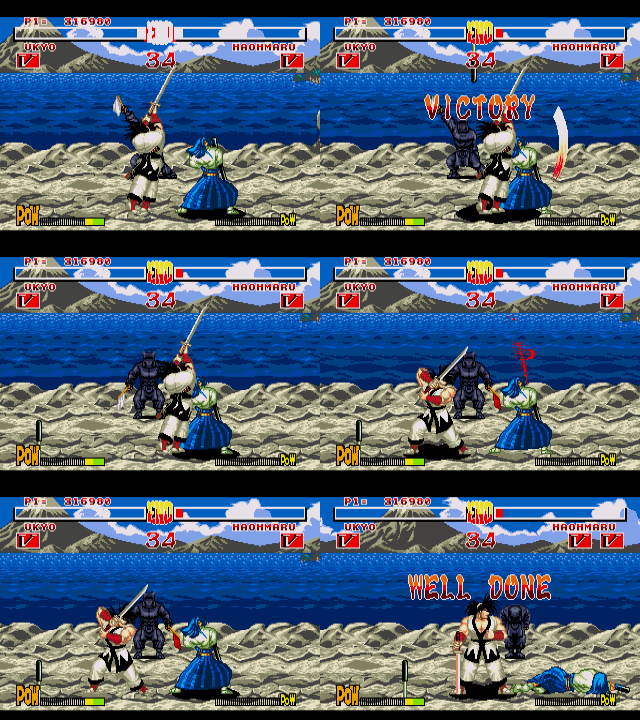
This is what Genesis does that Nintendon't.
Yet even they weren’t as exciting as the originals. The Genesis was a smaller canvas than the Neo-Geo, and designers had to cut corners to make its games fit. Such is the case with Samurai Shodown, the best of the Neo-Geo conversions on Sega’s 16-bit system. In some respects it’s remarkably close to the original, but there are some features from the arcade game that the developers didn’t even try to include. Blubbery bandit Earthquake was squeezed out of the cast, leaving a gaping hole in the character select screen, and the camera is set at a fixed position, which takes away from the cinematic quality of the fights. The music is also a sorry spectacle, capturing exactly zero percent of the intensity and ancient Japanese flavor of the arcade game.

Still, the Genesis version of Samurai Shodown has just as much going for it. The characters are huge, brightly colored, and crisply drawn, and they animate just this side of beautifully, as you can see from these brief clips. The control is actually improved from the Neo-Geo original, with three dedicated buttons for both slash and kick, and the voice samples that are normally as smooth as granola on a Genesis sound remarkably clear here.

It’s no substitute for the Neo-Geo version, but Samurai Shodown is a good sight better here than it was on the Super NES, with its fights seen from three counties away and with a soundtrack performed inside a sewage drain.

#34: FIRE SHARK

Boy, do I have fond memories of this! Fire Shark was the first good game I had for the Genesis (no, Altered Beast and DJ Boy most certainly do not count). It’s an overhead view shooter, very much in the same vein as Raiden Trad, Truxton, and any one of a number of games where you frantically flail on the bomb button in times of distress. That’s not going to get you very far here, though… there’s a slight delay before the bomb explodes, forcing you to carefully time their use.

Nothing can withstand the might
of your bombs! NOTHING!
There’s one thing Fire Shark does that the millions of other shooters on the Genesis don’t… when your plane is clipped by a bullet or crashes into oncoming air traffic, you’ve got two seconds to keep firing before you go down in flames. This serves no purpose other than to give the player a false sense of hope, but it’s a nice touch. Incredibly sadistic, but nice.

Fire Shark was developed by Toaplan, a game company that’s best known for that annoying All Your Base meme but should be remembered for its excellent arcade games, including Out Zone, Snow Bros., and Alcon/Slap Fight, whose enhanced Genesis port missed this list by that much. The game was distributed in the United States by Dreamworks… not the Shrek guys, but a division of Toy Soldiers. Nobody knows for sure what Toy Soldiers was, but Sega Retro suggests the company may have been a part of Japanese publisher Nippon Computer Systems.

#33: MORTAL KOMBAT 3

I’ve always preferred Street Fighter to Mortal Kombat, and to be perfectly frank, this is not the kind of game that shines on the Genesis hardware, with its weak voice digitization and low color output. Nevertheless, Mortal Kombat 3 was as good as it got for fans of the series, if those fans couldn’t afford a Super NES.

Back when Acclaim owned the rights to the home versions of Mortal Kombat, the games were ported to Sega systems by the godawful design studio Probe, makers of such “fine” products as Back to the Future III and the disappointing GameCube conversion of Crazy Taxi. Fortunately, when series creators Williams took the reins, they threw Probe out the door and hired Sculptured Software to design the Genesis version of Mortal Kombat 3 instead.

Sculptured Software had previously created the sublime Super NES version of Mortal Kombat 2, so you knew Mortal Kombat 3 on the Genesis had to be a step up from the previous two games. It is indeed as good as the hardware would allow, with more voice, better music, and the same intense action as the arcade original. Some people balked at the addition of dial-a-combos and a run button, but these features go a long way toward speeding up the gameplay and keeping it competitive with Street Fighter II, which had shifted into turbo the year before.

There was a sequel, Ultimate Mortal Kombat 3, but you don’t want that. You’d be better off downloading the fan hack Ultimate Mortal Kombat Trilogy, which offers all the characters Sculptured Software had to trim from the supposed upgrade, plus more fatalities than you can shake a severed limb at. Most of them don’t make sense and seem cobbled together with existing sprites, but that’s Mortal Kombat for you!

One last thing: Mortal Kombat 3 uses the same typeset as the decidedly more lighthearted Waku Waku 7, released years later for the Neo-Geo. Evidently, it was a really popular font back in the 1990s.

One other last thing: both Sculptured Software and Probe were subjected to the worst torture one could inflict on a game company, being absorbed by Acclaim in the late 1990s. When the nefarious crap factory went out of business, the latter company considered starting a new design team called Exclaim, but couldn't scrape together the capital for it. (Maybe the potential investors played some of their games and ran for their lives.)

#32: DESERT STRIKE

Desert Strike, based loosely on the first war in Iraq, is one of the deepest action games you’ll find on the Sega Genesis. There are nearly a half-dozen objectives, a hundred hidden items, and countless enemies in the first mission alone!

One down... uh, two hundred
thirty six to go.
It’s also one of the toughest games you’ll ever sink your teeth into… and vice versa. After you pop this into your system, you’ll swear more before 9 AM than most gamers will all day. Success in Desert Strike (if it ever comes at all) depends not only on fast reflexes, but obsessive management of your armor, fuel, and limited supply of missiles. Run out of either of the first two and you’ll crash… run out of the latter and you’re as good as dead. Dark Souls has got nothing on this one.

Desert Strike is the first in a series of murderously difficult military themed shooters by Electronic Arts, including Jungle Strike (blow up Latin America… for America!), Urban Strike (blow up the inner city… for America!), and the advanced Saturn sequel Soviet Strike (blow up Russia… for America!). You’ll spend so much time indiscriminately blowing up people who aren’t you that you’ll wonder if you’re really one of the good guys.

The British press came to the same conclusion, angrily criticizing the storylines in the four games as “uneasily right wing,” “jingoist,” and “ugly American idiocy.” It’s a small wonder Electronic Arts didn’t respond to the criticism by releasing London Strike.

#31: SAGAIA

Taito had a Dr. Jeckyl and Mr. Hyde approach to the Sega Genesis. When it was bad, it was very,very bad, subjecting players to monstrosities like Growl, Rastan Saga, and Chase HQ II while cackling with sadistic glee. However, before the moon came out and its worst instincts were unleashed upon a hapless public, Taito crafted exceptional arcade conversions. One of their greatest gifts to mankind (or at least those members of the human race with a Genesis) was Sagaia.

Fish 'n ships.
Sagaia was the sequel to a shooter called Darius, which had two claims to fame. The first is that it’s got an aquatic theme, with steel-plated sealife serving as your enemies. The second is that the action is stretched across three screens, predating the widescreen monitors of the 21st century. This meant three times the onscreen hazards, and three times the challenge for the overwhelmed player.

Naturally, the Genesis couldn’t output to three screens at once, so Taito wisely chose to shrink down the playfield and added letterboxing to simulate an extra wide screen. It’s a fair compromise that worked much better than the later Saturn version of Sagaia, which let the player adjust their view of the action, either crushing the playfield into a tiny, distorted rectangle or leaving them without enough room to dodge bullets.

As shooters go, Sagaia isn’t the best the Genesis has to offer, but it’s a satisfyingly solid experience, with seven levels chosen from a massive pool of twenty-six, imaginative bosses, and a soundtrack that seems lifted from a Venusian game show. One highlight is Olga Breeze, the ethereal, clap-filled track that plays while you’re flying over the surface of the sun. You’ll probably want to listen to this strangely compelling piece of electronica on YouTube, because while actually playing the game, it’s often drowned out by the sound of your gunfire.


More to come!

Friday, January 24, 2014

Genesis DOES! (part 1)

I have a horrible secret to reveal to you all...

...I'm a furry.

That's probably not that much of a surprise, is it? After all, the mascot of my old web site, if you can remember that far back, was this kid.


He was never especially popular with my readers (gee, who'd have thunk that a diapered brown bear wouldn't go over well with gamers?), so I shuttled him off to an art gallery elsewhere on the internet. From that point on, I tried to keep my gaming and anthro interests separate, but lately the two halves of my personality have been on a collision course, and there's nothing I can do (or care to do, frankly) to stop them. Really, you guys are mature enough to accept my eccentricities, or at least politely ignore them. This isn't Something Awful, after all.

"Yeah, if it was, people would be reading it!"

Shut up, Byron.

Anyway, I've been on a Sega Genesis kick lately, and decided on a whim to review my forty favorite games for the system on my Tumblr page. Since nobody's been reading those, I've decided to bring them here as well, where they might catch a few stray eyes. Here now for your reading pleasure are the first five of the games in this special eight part feature...


That's me as a sloth bear.
You know, like Baloo from The Jungle Book and Talespin?
Just... just look it up on the internet.
#40: BIO-HAZARD BATTLE

Kicking things off is Bio-Hazard Battle, a supremely disturbing side-scrolling shooter that flew under the radar of most American gamers. The game was titled “Crying” in Japan for reasons which aren’t entirely clear, but it’s pretty obvious why Sega rechristened it when it was brought to the West. After all, it was released around the same time as a controversial film called The Crying Game, and Sega didn’t need that headache.


Anyway, Bio-Hazard Battle takes the bio-organic motif of R-Type and cranks it up to seventy five. The enemies are uncomfortably reminiscent of what the vet found in your cat, and even the player’s ships are bizarre, taking on the forms of insects and deep sea creatures. The running theme here is “creepy.”

The gameplay is kept straightforward, with just four power ups and two buttons. One button lets loose a thin stream of bullets; the other charges up a devastating blast. Each ship also has a satellite that orbits around it, catching a handful of the many, many shots that fill the screen at regular intervals. Bio-Hazard Battle is hard, sometimes to the point of being unreasonable. Nobody would blame you for choosing the easy difficulty setting, or cheating and giving yourself infinite lives.

The animation is a thing of grotesque beauty, with segmented worms undulating as they soar through the sky and your ship shattering like glass after it collides with them. The entire game looks marvelous, in an extremely pessimistic, nightmare-inducing kind of way. Huh, maybe that’s the reason the Japanese called it Crying…

#39: GRANADA


Adapted from the crazy-powerful X68000 computer, Granada combines the tank combat of Namco’s Assault with the labyrinthine levels and crowd control of Atari’s Gauntlet. You’ll embark on a series of search and destroy missions, first hunting down generators spread across a vast playfield, then challenging a well-armed and often gigantic boss. The action is accented with a futuriffic soundtrack that would be right at home in an episode of Airwolf.

Granada was designed by a mid-sized Japanese developer called Wolf Team, which you may recognize as Namco Tales Studio. These days, they make RPGs and very little else, but back in the 1990s, they were known for intense, ambitious, and slightly wonky action games like this one. Some of the Wolf Team games that didn’t make this list include El Viento, Time Gal, and Earnest Evans… not the life story of Chubby Checker, but a platformer starring a man who desperately wants to be Indiana Jones but looks more like one of Pinocchio’s friends.

By the way, the game’s not called X-Granada-X, despite what the title screen may lead you to believe.

#38: ROADBLASTERS

This game, a simple but incredibly addictive and stylish racing title, experienced a renaissance after being featured in a pivotal scene from the Disney film Wreck-It Ralph. However, I loved it before it was cool… especially on the Atari Lynx, but also on the Sega Genesis.

The Lynx version was technically more complete, with all the voice samples from the arcade game, but the Genesis port of Roadblasters had its own advantages, like a higher resolution and perfectly reproduced sound effects. It’s so close to the arcade game it’s downright eerie, translating into the same white-knuckle fun you had in the bowling alley or the rec room at your college. (It’s actually more fun than playing the game on MAME, which is so dependent on analog control that it’s practically impossible to play without it!)


Here’s something you may have missed… Roadblasters was actually designed to promote a series of toys released by Matchbox in the 1980s. That music you hear in the attract mode is actually from a commercial for the toys!

#37: PHANTASY STAR IV: THE END OF THE MILLENNIUM

It almost feels like heresy to admit this, but I never cared for the Phantasy Star series. As a fan of twitchy arcade games, it’s not the kind of experience I hoped to get out of my Sega Genesis… and even if I wanted a role-playing game where the computer does all the fighting for me, I would have been better served with the Super NES and its own Final Fantasy series.


There were a lot of irksome design flaws in Phantasy Star I could never learn to accept, like the muddled science-fiction setting (why is there a mage in my party of futuristic monster hunters?), the unremarkable enemy designs, and an interface that’s almost as user-friendly as trying to program your VCR. Wat the hell is WAT? Is there a practical use for RYUKA? Would someone in this universe ditch the MS-DOS file names and just speak some bloody English?

Having said all that, even I have to acknowledge that Phantasy Star IV is the pinnacle of a genre the Genesis never did particularly well. The End of the Millennium was originally designed for the Sega CD, and you can see those lofty aspirations in its frequent, gorgeously drawn cut scenes (and its price… good lord, this thing was a hundred dollars when it was first released!). Even when it comes dangerously close to testing your patience with a not quite there English translation or way too many damn enemy encounters, Phantasy Star IV has a knack for winning you over with charming, sharply defined characters and memorable dialog. When a pervy old owl reveals Alys’ measurements, the ball-breaking bounty hunter reveals herself to him, and punches him out of his chair!


Sometimes, you almost wish Phantasy Star IV had been released on a compact disc, so the game could have lived up to its full potential. A little voice acting and some animation during the cut scenes would really have brought this one over the top.

#36: WILLIAMS ARCADE’S GREATEST HITS

Arcade’s Greatest Hits holds the curious distinction of being one of the only classic game collections for the Sega Genesis. That genre wasn’t really a thing until the mid 1990s, when uberconsoles like the Sega Saturn and Sony Playstation had the muscle to emulate arcade titles from the 1980s.

The Genesis, blast processing and all, did not have the power to emulate these golden oldies. However, these five conversions by Digital Eclipse are the closest a game console ever came to arcade perfection before emulation made that a guarantee. There’s a bit of slowdown in some of the more intense games- the transition between levels in Robotron: 2084 is especially affected by this- but past that the games are exceptionally close to the originals. This extreme attention to detail was a Digital Eclipse trademark, until the company was purchased by Foundation 9 and the developers fled to greener pastures.

So, what games will you find on Arcade’s Greatest Hits? Well, there’s Defender, the viciously hard side-scrolling shooter with an intimidating control scheme. The arcade game had buttons for thrusting and even changing directions, but like most home conversions, you can wimp out and use the more intuitive joystick for both functions. Stargate is more of the same, except with more buttons, more enemies, and lots more personality. Once you’ve played Stargate, you’ll have a hard time going back to the original.

Joust is another arcade favorite, featuring an ostrich-riding knight doing battle with gladiators on buzzards. Repeatedly tapping the button (any button, the game’s not picky) sends your steed into the heavens, and colliding with the gladiators while your bird is higher than theirs turns them into eggs, which you can collect for bonus points. NES fans will notice that the game is very similar to Nintendo’s own Balloon Fight. Some people say that Balloon Fight is better, but of course, those people have no taste.

Rounding things out are Robotron: 2084 and Sinistar. Robotron is the world’s first dual-stick shooter, and is every bit as intense as later entries in the genre like Geometry Wars and Beat Hazard. Sinistar is the black sheep of this collection, a ferociously intimidating shooter that’s a bit like Asteroids, if the screen stretched infinitely in all directions and you were constantly being pursued by a hungry chrome lion head. If it’s your first time, keep a spare pair of underwear handy for when Sinistar awakens.

A second game in the series, Atari Arcade’s Greatest Hits, was released for the Super NES, but missed the Genesis, skipping right to the more capable Sega Saturn. It’s a good game in its own right, but Asteroids and Super Breakout seem a little passive next to the orgy of bright colors and big explosions in the Williams collection.

...

More to come!

Tuesday, January 21, 2014

Makes an Ass out of U and Wii

A year after I bought my Dreamcast, Sega cancelled it. Months after I bought my Saturn, Bernie Stolar made the infamous comments that it was a "stillbirth" and the system was "not Sega's future." Today, I purchased a Nintendo Wii U, and Destructoid reported that a new Nintendo console was coming soon. It wasn't just the same day according to the report's time stamp, it was practically the same minute. This story was published as I was sliding my debit card through the reader.

Man, it never fails.

Anyway, I'll talk about my experiences with the system in a future post. As soon as the steam stops shooting out of my ears.