Monday, January 31, 2022

Spectral Analysis

Roughly, uh...

(counts on fingers, runs out of fingers)

...twelve years ago, I wrote a series of articles for the late, lamented 1UP web site featuring the ZX Spectrum. This budget priced home computer was a regional phenomenon, ubiquitous throughout its native Great Britain in the 1980s but a total mystery to budding tech nerds in the United States. It was one of those things "Yanks can't wank," to quote YouTube's "Guru" Larry Bundy.

After learning about the machine and taste-testing some of its software in an emulator, I took it upon myself to share that knowledge with 1UP's readers, in a regular feature titled "What the Hell is a Spectrum?" It was a crash course in Britain's best kept secret, a makeshift game console with thousands upon thousands of titles which had somehow escaped America's notice.

It had games from Donkey Kong to Street Fighter II with nearly everything in between, but in hindsight, it's not hard to understand why the Spectrum was ignored in this country. Where home computers were concerned, America was Commodore's turf, thanks to the aggressive pricing and superior hardware of the C64. While it wasn't much to look at on the outside, sharing the ugly breadbox design of the earlier VIC-20, the C64 was better suited to video games, with sprites that could move independently of the playfield, a custom sound chip, and a rich color palette. The Spectrum didn't have any of these things... hell, even a joystick port wasn't standard equipment on the earlier models, forcing players to buy a peripheral to add that functionality. (And probably some blue tack to keep it in place. Clive Sinclair's electronics weren't what you would call sturdily designed. Explodey, but not particularly robust.)

So the Spectrum never came to the United States in an official capacity... but its designer Sinclair Research and Timex did take a swing at the American market with several home computers, ending with the Timex-Sinclair 2068. The two companies must have realized that the Spectrum had no hope of competing with the Commodore 64 as a game system, because the 2068 is better equipped for that purpose, sporting an arcade-tested sound chip, more RAM, dual joystick ports, and extra graphics modes with more versatile color handling. Oh, and it looks a lot more stylish than the C64, too. Check out that clean, compact design and that silvery sheen! Truly, a magnificent specimen of early '80s speculative futurism!

The only problem is that there were tons of computers in the American market all hoping to topple the industry leader. Without brand recognition, software support, and the star power of Alan Alda, William Shatner, or Charlie Chaplin (quite dead, yet somehow motivated to shill consumer electronics), Timex-Sinclair had no chance of competing in the United States. The cruelest cut is that while the TS-2068 was objectively better than the ZX Spectrum, it could only run ten percent of that system's enormous software library, and zero percent of those titles could take advantage of its improved hardware. What kind of dope would even think of buying a computer like this?

Uh... me, actually. But I have reasons! The first is that someone had offered a Timex-Sinclair 2068 for the price of shipping on Reddit, and considering that prices for video games and home computers have rocketed into the stratosphere over the last two years, I just had to get in on that. The second is that while the TS-2068 isn't compatible with the ZX Spectrum by default, it can be persuaded to run nearly all of its games with the aid of a reasonably priced adapter. I'm also pretty sure someone's found a modern workaround for its reliance on cassette media... perhaps an app that would let me connect a smartphone to its mic port for lightning fast loads and almost infinite storage space. Look, I loaded games from cassette back in the 1980s with the VIC-20. I ain't going back to that again. 

Also, I did mention the silver finish, right? 


* Special thanks to Wikipedia for its assistance in researching this blog entry. Also, I know Texas Instruments had a celebrity spokesman too. He's dead to me now, and it's not just because of Leonard Part 6.

Sunday, January 30, 2022

Rex Fatalis

Mortal Kombat was a game that demanded your
attention in 1992. Well, maybe not quite this
much.

Remember if you will the distant year of 1993, when the white-hot fighting game Mortal Kombat made its debut on home game consoles. We were all excited for its arrival, and pretended to be excited after taking the cartridge home and slapping it into our 16-bit systems of choice, but the sad reality is that neither the Genesis or Super NES ports met our expectations. 

See, there's your problem, Mac.
The Super NES game by Sculptured Software sure looked like the arcade game, taking full advantage of the system's lush 256 color palette, but the gameplay was kind of sluggish, and Nintendo's censorship turned the scarlet sprays of blood erupting from your opponent into brown clods of dirt. Meanwhile, the Genesis game by Probe was, well, by Probe. The fights were faster and the control was tighter than it had been on the Super NES, but there was a lack of panache to the presentation, with fewer voice samples, less detail in the backgrounds, and an appalling lack of color even by the system's humble standards. Even the heart Kano tore out of his opponent's chest seemed to phone it in, squirming around in his hand like a flabby fish eager to be put out of its misery.

For Super NES owners, the best cure for the Mortal Kombat blues was to wait for the sequel, an exceptional port of what's regarded by fans as the best game in the original trilogy. The inclusion of all the blood and gore from the arcade version wasn't going to make parents happy, but they weren't the ones playing the game. Things weren't so cut and dry for Genesis fans... Mortal Kombat II was only passable on that system, a victim of both the console's audiovisual limitations and a typically underwhelming conversion by Probe. Satisfaction would only arrive on the Genesis in 1995, when Sculptured Software brought an admittedly fugly but structurally solid port of Mortal Kombat 3 to the system.

The original game (left) vs. Master Linkuei's revision (right).
MKAE adds clouds overhead, as well as a more realistic
shade of blue-grey for its sky, as opposed to the turquoise
in the official release.

There were eventually alternatives to the first Mortal Kombat, but the original remained sadly lacking. Fortunately, a team of hackers led by Master Linkuei are determined to right past wrongs by giving Genesis owners the port of the original Mortal Kombat they should have gotten in the first place. Titled Mortal Kombat Arcade Edition, this conversion uses Probe's lackluster effort as a foundation, but builds onto it with more voice, meatier sound samples, and discernible stone surfaces where there was once smeared globs of pixels. 

Again, the original is on the left, and Master Linkuei's
revision is on the right. The kombatants seem to stand on
nothing in particular in Probe's game, while the new version
features a cracked stone floor with the skeleton of an
unlucky fighter lying in the foreground.

Mortal Kombat Arcade Edition still doesn't look as nice as the Super NES game, and it still has Matt Furniss' irritatingly wobbly soundtrack, but there are nevertheless abundant improvements over the official release. Fatalities now begin with a threatening musical dirge, there's better use of color, with fewer peach-colored pixels clinging to the edges of characters, and minor details like the clouds rolling past in the Pit stage and the lightning crackling around Raiden have returned. It adds impact and artistry to a game that felt alarmingly devoid of both when it first debuted.

Today, there are all kinds of ways to play the first Mortal Kombat thirty years after its debut, but if you insist on doing things the old-fashioned way with a 16-bit system, Mortal Kombat Arcade Edition is your best option. Now if only someone would do something about that dire Genesis conversion of World Heroes. What's that? Not a chance in hell? Well, it was worth a shot...

Thursday, January 20, 2022

Well, THAT came out of left field!

Microsoft recently announced its intentions to purchase Activision, and... frankly, I'm struggling to find an end to this sentence. On one hand, it seems to be the only way to get rid of detested CEO Bobby Kotick, who will reportedly bail from the company with a golden parachute strapped to his back once the deal is finalized. On the other, Microsoft has been gobbling up a lot of companies lately, recently swallowing Bethesda whole and washing it down with a tall glass of Double Fine. These habitual acquisitions are becoming a problem... someone should stage an intervention before someone walks into Bill Gates' mansion and discovers that he's choked to death on Electronic Arts.

There is one silver lining to this, and I'm not just talking about Bobby Kotick's impending ouster. According to Microsoft's Phil Specter, all the companies within Activision who were forced to toil away on Call of Duty will be freed from this terrible fate, and allowed to make games that are a better fit for their unique skills. This news was announced on Twitter with a meme that carries the same high sense of relief and spirit-lifting liberation as, say, a hostage release or the last episode of M.A.S.H. 


Let it all out, guys. The nightmare is finally over!

In other "how did this even happen" news, someone ported Tomb Raider to the Game Boy Advance. This is not an adaptation with creative liberties out the wazoo, as was so often the case on the system, but rather a straight port of the Playstation game. It's not entirely free of compromise, with a lower frame rate and less detail, but seeing a Game Boy Advance handle a fully polygonal video game that was all the rage on consoles five years before its release is a thing of wonder, like watching an ant carry a leaf many times its size back to its nest. This shouldn't be possible, yet there it is, happening right in front of your eyes!

Saturday, January 15, 2022

Tip-Toe Through the Tombstones

It's almost a cliché to bag on an easy target like Kotaku, but I feel that some recent posts on the long-running, long-vexing video game journal deserve a response. After it was revealed that Microsoft had quietly stopped manufacturing Xbox One consoles in 2020 to step up production of the Xbox Series S and X, Luke Plunkett had this to offer in way of a eulogy...

Goodbye to the Xbox One, the most pointless console I have ever owned.

Not to be out-douched, contributor Ari Notis added this...

The Xbox One is officially dead. RIP. It will not be missed.

This was followed up with such observations as "the Xbox One was a trial run for the Xbox Series X," "Toward the end of its run, if you played a glossy AAA game, you could almost feel the thing wheezing under the pressure," and most pointedly, "The Xbox One sucked!"

It must be one of those casual work days, when Kotaku gets to be a blog and throw objectivity and decorum out the window, rather than one of the days when they call themselves a reputable news source, so they can sneak their foot in the door of an industry trade show. In way of a rebuttal, I'll just let Spicoli say what I'm thinking really loudly.

I'll admit, I've had qualms with the Xbox One throughout its lifespan. The launch was a disaster thanks to the machinations of Don Mattrick, who hoped to tie the system to all kinds of onerous digital rights management, but was undone when he realized that none of the other console manufacturers planned to follow his lead. Mattrick did serious damage to the Xbox brand name, but Microsoft spent the next seven years rectifying his mistakes, sending a Day One patch to Xbox Ones which eliminated restrictions on physical games, and putting the all-seeing, all-creepy eye of the Kinect into retirement shortly afterward.

There was also the user interface, which was intuitive but puzzlingly slow for at least a year after I purchased my Xbox One S. It could take upwards of three seconds to make the constipated cursor move from one game in your library to the next, in contrast to the speedy interface of the considerably older Xbox 360. Admittedly, this should never have been a problem in the first place, but like Mattrick's dark ambitions, the sluggishness of the GUI was ultimately addressed with patches. 

My point is that when Microsoft makes mistakes with the Xbox brand, it typically acknowledges and fixes them, often at great expense. The oversized "Duke" controller included with the original Xbox was eventually replaced with a smaller, more ergonomic model. Early Xbox 360s had an abysmal failure rate, but the systems were repaired or replaced free of charge by Microsoft, and later models were designed to be more reliable. The Xbox One was originally designed to be the most user-hostile piece of consumer electronics since Coleco's ADAM, but when fans expressed their frustration, Microsoft listened, changing course almost immediately.

On the other hand, when issues crop up with Sony and Nintendo's respective consoles, the response from the two companies is "tough titties." We all remember having to turn our Playstations upside down to play games, or not being able to play games at all thanks to disc read errors on the Playstation 2. The Playstation 4 is more reliable by comparison, but is needlessly encumbered with constant firmware updates that seem engineered to annoy the player rather than improve the overall experience. If you happen to install a game from disc and purchase it digitally later, you'll have to install it all over again, a process that can take many hours on a slower internet service. 

As for Nintendo, the Switch's failure-prone Joycons have been giving people fits for years, and this issue still hasn't been definitively addressed. Sure you can send the controllers back to the company for repairs, but after five years, you should be able to use a Joycon without worrying that it'll fall apart in your hands. Microsoft put the red ring of death to bed with the Xbox 360 S and E... what's Nintendo's excuse?

I'm not going to sugarcoat my experience with the Xbox One... it hasn't always left me with happy memories. But in the five years that I've owned the Xbox One S, it's become my go-to game console, seeing regular use while the Switch and Playstation 4 gather dust. It's the undisputed king of backward compatibility, with hundreds of games from the Xbox and Xbox 360 libraries running on the system in both disc and digital forms, and even improved with sharper resolutions. Native games run fine as well... obviously they're not going to run as well as they would on the latest hardware, but I've played fifty hours of the 2020 release Yakuza: Like a Dragon, and it hasn't brought my Xbox One S to its knees as Notis  suggests. 

Finally, when I do eventually upgrade to the Series, I'll be better served with it than the Playstation 5, as all of the games I purchased for the One (and the 360, and the classic Xbox) will be right there waiting for me, and appropriately upscaled to the new hardware in some cases. The Xbox One will ultimately grant me a smooth transition to its successor, unlike Sony, whose statement that "we believe in generations" sounds a lot to me like "you'll start your game collection all over again and you'll like it."

The writers at Kotaku might be dancing on the grave of the Xbox One, gleefully toppling tombstones and kicking over flower pots, but I won't be joining them in their mean-spirited mambo. It took a while for it to get there, but the Xbox One eventually became my favorite console of the last generation... and it was Microsoft's dedication to the machine in spite of a rough start and disappointing sales that put it at the top.

Saturday, January 8, 2022

Game Collecting Sucks in 2022

That's the title. No cute puns or references, I'm just dropping a truth bomb on your head right from the start. 

I went down to Tucson for my birthday last Sunday, and was aghast by the prices at the two Bookmans I visited. Three hundred and forty dollars for an Atari Lynx? Really? Can I have some of what you're smoking when you're done with it, or is there anything left? Hell, the stupid Analogue Pocket only ("only") costs $219, and that has the potential to play games for a half-dozen systems, with a crisp LCD screen that doesn't turn you into Hans Moleman when you try to make out the finer details. Three hundred and forty dollars for a damn Atari Lynx. What the absolute hell?

Worth its weight in gold, apparently.
(image from Wikipedia)

It's not just semi-obscure handhelds that are getting their prices raised through the roof and beyond the Earth's gravitational pull. The Playstation Portable, long a safe haven for penny-pinching collectors, has seen its game prices creep upward over the last two years. Before COVID, you used to be able to fish through a big 'ol container of loose PSP games, and while many of those were commons and sports titles, there were some gems hiding amongst the Maddens and Daxters and whatever the hell Beaterator is, often for five dollars or less. These days, though? Good luck, because brother are you gonna need it! I found loose copies of Gradius Collection for fifteen dollars and Puzzle Quest for five, and felt exceedingly grateful for this thin gruel. This would not have been a good haul in 2019! I'm a little disgusted with myself for calling that a haul now!

On the plus side, I also scrounged up a copy of Bust-A-Move DS, which only cost five dollars and remains one of the high points in the long-running series. Pulling back an onscreen rubber band to fire bubbles gives the game a more tactile feel than Bust-A-Move Pocket on the PSP, and the general ambiance strikes me as more faithful to early entries in the series than BAM Pocket's head-scratching Halloween motif. 

Slightly more expensive at ten dollars was the Xbox One Kinect, and while I didn't really need one of these, it's nevertheless something I wanted to try for myself. I was a fan of the original Xbox 360 Kinect, and this version is supposed to be a lot more cutting edge, recognizing players as more developed forms with a sense of depth and mass, rather than stick figures. Unfortunately, Microsoft was so desperate to ditch the Kinect after its initial failure that later Xbox One systems, including my own Xbox One S, require an adapter to work with it. So until I get that adapter and a couple of games, I won't be flailing my arms around like a Muppet who just smoked whatever the Bookmans people were enjoying before they priced that Atari Lynx.

Thursday, December 30, 2021

A Few of My Favorite Things, 2021 Edition

It's almost the end of the year, and you know what that means!

"Heaving a sigh of relief that 2021 is almost over?"

Well, that too, but it's also time for that familiar video game journalism cliche tradition, the end of the year awards! I haven't played enough games from this year to cover those exclusively, so I'll be widening the net to software, hardware, and accessories I experienced this year, whether they were released in 2021 or not.

Will this get followed up with a "worst of" list? It's certainly a definite possibility! Check local listings for time and availability.

EVEN BETTER THAN THE REAL THING
Black Bird
Onion Games

You're not losing track of bullets in
backgrounds like these.
(image from Nintendo)


If you wanted to be reductive about it, you could call Black Bird a clone of Sega's silly shoot 'em up Fantasy Zone. However, that would do the game a disservice, as Black Bird goes a long way toward addressing all the nagging issues that made Fantasy Zone a drag to play. Instead of assaulting the player with blinding psychedelic colors, Black Bird opts for dreary, muted tones in the background, which not only sells the dingy Victorian era setting but makes it easy to focus on the flood of bright orange arrows coming your way. Instead of shops that put the brakes on the action to sell you weapons with steadily rising prices and the robust staying power of Hassium-271, you power up your gun with bouncing gems, and any boosts in firepower stay with you for the remainder of the game.

Finally, instead of losing interest after five minutes of Fantasy Zone's bright colors and questionable deaths, you'll stick with Black Bird until the end... even if that end happens to be delivered by a drinking bird in a tutu. It's a weird game, but compellingly weird, like the early films of Tim Burton, rather than loud and obnoxious, like that Yellow Submarine meets McDonaldland thing Sega's got going on with Fantasy Zone. If you don't come back for the intuitive gameplay and the perfectly tuned challenge, you'll give Black Bird one more spin for the soundtrack, an opera apparently performed by Dudley Do-Right and Popeye the Sailor after throwing back a few too many beers.

THE THING THAT WOULD NOT DIE
Tie, Dreamcast and Playstation Vita
Sega and Sony

The Dreamcast had this award wrapped up last year, thanks to the release of dozens of games originally designed for the Atomiswave arcade hardware. Granted, not all of these games were good, but between Dolphin Blue, King of Fighters 11, and Fist of the North Star, there were plenty of reasons to dig Sega's last console out of the closet for an encore performance. 

Unfortunately, this Dreamcast renaissance couldn't last forever, and when the top tier Atomiswave titles were exhausted in February, all that remained were throwaway games in the Sammy Family Entertainment Series. (Any family that would be entertained by this series must live extraordinarily dull lives.) That left the Playstation Vita to pick up the slack with over a dozen classic games, mostly of the first-person shooter variety, ported by fans. 

Personally, the most tantalizing of these homebrew titles was Space Cadet Pinball, an addictive and wonderfully noisy silver ball sim that was oodles of fun on Windows computers back in the 1990s. It's a little awkward to start on the Vita, but once you've launched that first ball into orbit, good luck trying to come back down to Earth.

TINY BUT MIGHTY
Tie, Neo-Geo Mini and Super NES Classic
SNK and Nintendo
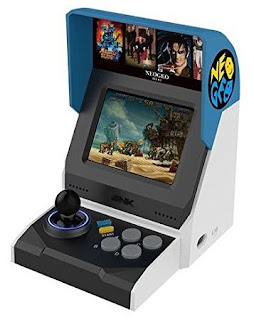
My beef with the Neo-Geo Mini is
that it looks like some arcade
cabinet that exists somewhere,
but not at all like a proper
Neo-Geo MVS unit.
(image from Amazon) 
By my estimation, the problem with mini-consoles is that you obsess over them for a week, maybe two, then forsake them shortly afterward. The Neo-Geo Mini manages to buck this trend, possibly because its built in screen and the instant gratification provided by its games make it easier to pick up and play than its competitors. Stick a battery charger on the back and it becomes completely self-contained, making it faster and easier than it's ever been to get a quick endorphin rush from a couple rounds of Mutation Nation.

Not far behind is the Super NES Classic. It's not as convenient as the Neo-Geo Mini, but the interface, the quality of the emulation, and the games available are all outstanding. Yes, it's got half as many games as the Genesis Mini, but nearly all of them represent the best this system has to offer, unlike the Genesis Mini where at least a half dozen of the available titles are best left forgotten. Besides, if you want more games, just add some with HackChi. (Just don't tell Nintendo about it afterwards.)

SECRET TOY SURPRISE
Gaplus, in Namco Museum Archives 2
Bandai-Namco

Gaplus' headlining feature is that
you can actually grab the bugs
yourself, instead of vice versa.
(image from Internet Archive)
As classic collections go, this isn't one of the better ones. Like its predecessor, Namco Museum Archives 2 is an assortment of creaky old NES ports, rather than the arcade games you really wanted. You can't remap the buttons, and a small menu window hangs distractingly over the bottom left corner of the display... it's not impossible to turn it off, but Namco didn't make it especially easy, either. 

However. What makes Namco Museum Archive 2 worth a look anyway is a surprisingly tight NES conversion of Gaplus, the third game in the Galaxian series. Gaplus was released around the time of the video game crash of late 1983, and feels desperate as a result, overburdened with features that sometimes add to the experience but usually don't make much sense. 

Having said that, this NES port of Gaplus is a technical marvel, as dead on as an arcade conversion gets on the hardware. Where this came from or why we're getting it now is anyone's guess, but hey, I'm happy to have it!

FIST, MEET FACE
Mortal Kombat 11 Ultimate
Warner Bros. Games

The latest Mortal Kombat game dabbles in time travel, with the 1990s versions of the characters teaming up with their older, wiser counterparts to defeat the scheming chronomancer Kronika and her daughter Cetrion. It's a convenient way to tie up loose ends in the plot and introduce guest stars like Robocop who probably shouldn't exist in this universe, but beyond that, it feels like introspection on the parts of the developers. We're all a lot older than we were when the first Mortal Kombat first hit arcades in 1992, and MK11 was an opportunity for Ed Boon and his team to reflect on what this game used to be, and what it's become in the years since.

On a fundamental level, Mortal Kombat 11 is very much like the first three arcade games, with 2D gameplay, combos performed with action buttons tapped in rapid sequence, and uppercuts that do hefty damage while launching your opponent a safe distance away. However, the gameplay has evolved, with "fatal blows" offered as a risky but wickedly satisfying way to tilt the odds in a losing match, and characters that can be customized with new outfits and even alternate special moves. The graphics are vastly improved, as one might expect from decades of technological advancement, but what you might not expect is the effort put into the story mode, which feels like a big budget action movie and fleshes out the inscrutable lore of the series.

There are plenty of great flagship fighting games for the Xbox One and Playstation 4, but Mortal Kombat 11 is easily the most ambitious and most fully realized of the bunch. Even the latest game in the Street Fighter series, once regarded as the high watermark for this genre, seems like an underachiever by comparison. It took nearly thirty years to reach the top, but ultimately, time was on Mortal Kombat's side.

BEST METROIDY, CASTLEVANIA-Y TYPE GAME
Iconoclasts
Joakim Sandberg

I used to love 'em as much as anyone else, but lately, the greatest challenge offered by search action games is just staying interested. I didn't finish Axiom Verge, didn't finish Timespinners, didn't finish Ori and the Blind Forest, and most certainly didn't finish Hollow Knight, which was praised by reviewers but just left me flat. Just what I needed, angsty insects. Where'd I leave my Raid?

Barring some occasional annoyances, this
was good to the 'clast drop.
(image from Steam)


Iconoclasts, though... that I did finish. I'm not sure what this game has that the other Metroidvanias don't... it's certainly more colorful than the titles I just mentioned, with top-shelf sprite work from its creator Joakim Sandberg. There's also the wrench, which functions as a melee weapon but doubles as a key for unlocking stubborn doors and triples as a means of conveyance. It's fun to charge up the wrench and catch a stray power line that sends you screaming through brick walls and into areas you previously couldn't reach. There's also the option to play in a "relaxed" mode whenever the need arises, taking the sting out of the endgame where you're expected to take down bosses many times your size.

It's not entirely without irritation, and the plot goes in some pretty strange directions, starting with a ruthless theocracy and ending with... uh, a parrot trucker hauling magic yogurt. However, Iconoclasts kept me in its thrall from beginning to end, which is the highest praise I can give to a game in this increasingly stale genre.

BEST "WHAT IS THIS I DON'T EVEN" GAME
Part-Time UFO
Nintendo/HAL

This Hamburglar girl shows up in several
scenes, trying to steal things. Typically
you'll get extra coins by grabbing her first.


And now for something completely different! Adapted from a smartphone game, Part-Time UFO challenges you to finish a series of odd jobs using a crane suspended from a flying saucer. Whether it's catching fish, hauling turnips, constructing robots, or keeping circus acrobats balanced on a tightrope, you've got a time limit to finish each job. If you've got the time to spare, you can fill it by finishing bonus objectives, which add to the difficulty but put a little extra cash in your pocket. That money in turn can be used to buy hats for your UFO, which may increase its abilities but mostly just make it look silly. 

Even as the jobs grow in challenge to the point where each narrow failure will threaten to pop a blood vessel, Part-Time UFO never loses its cheerful optimism. It also keeps finding new ways to use that crane, keeping the action fresh and unpredictable. It must have been as fun for HAL Laboratory to make Part-Time UFO as it is for Switch owners to play it, suggesting that it was wise for Nintendo to lighten its grip on the leash and let its subsidiary stray from the Kirby series, giving it time to creatively recharge. Other game companies should take notes.

BEST GAME, PERIOD
Yakuza: Like a Dragon
Sega

The numbers don't lie, folks. I've spent fifty hours with this game so far, and expect many more in the future. Why not? Like a Dragon is an incredibly robust and diverse experience, and it would probably take at least a hundred hours to absorb it all. It's a turn-based role-playing game, and yet also a successful extension of the long-running Yakuza series, with the same style and some of the same play mechanics. It's also (takes a deep breath) a dungeon crawler, a business management simulation, a racing game in the style of Super Mario Kart, a collection of Sega arcade games, and a compelling story about a disposable Yakuza thug finding his own value in friendship, justice, and the occasional delivery of super spicy kimchi.

"Hi, I'm Ichiban Kasuga, and I'll be your
poofy haired, goofball protagonist for the
duration of the game."
(image from Metacritic)
Sometimes that variety is to the game's detriment, with side stories distracting you from the side stories that distracted you from making meaningful progress in the main story. Tedious grinding for experience points (and job experience points, and personality points, and heaven only knows what other bars and gauges you have to fill) gobbles up an enormous portion of your playtime, and scenes that should be emotionally resonant lose a lot of their punch thanks to dead-eyed characters who set one defiant toe onto the edge of the Uncanny Valley. You guys do know Bioware was doing better cut scenes than this ten years ago on a last generation system, right?

Nevertheless, Yakuza: Like a Dragon has the same Jupiter-like pull as other classic role-playing games, which steal every spare minute from you and even a couple hours you can't spare. You know, legendary titles like Final Fantasy VI, Grandia, the early Suikodens, Elder Scrolls: Oblivion, and Mass Effect 2. When your game can be confidently mentioned alongside these greats, you know you've done something right.

Friday, December 24, 2021

Here Comes Santa Claus, There Goes 3DS

Somehow I doubt a 3DS would top Naruto's
Christmas list today. But he's all grown
up and stuff now, right? Maybe that old-ass
system got passed down to Boruto, or
Newruto, or whatever his son's name is.
(image from Video Games Blogger)

Season's warnings, everyone. Amidst the big sales on games for consoles and computers, there's a substantial but not well publicized holiday discount on games for the Nintendo 3DS. This is important, as rumors have been circulating that Nintendo will shutter the 3DS eShop as soon as next year. If you want some el cheapo titles for the dual screen, three dimensional handheld, this is both a golden opportunity and quite possibly your last one. Trust me on this... although Sony left its own digital storefronts open for its legacy systems after a public outcry, sales for the Playstation 3, PSP, and Vita have been all but non-existent for at least a year.

Nintendo Everything lists two dozen Atlus titles up for grabs on its web site, but the sale goes deeper than just one publisher, with parent company Sega and several others making significant cuts to the prices of their own 3DS titles. My humble suggestion is to get what you can while it's cheap, and more importantly, while it's there.