Saturday, August 10, 2013

Here Comes Franklin!

First things first... check out the new design for the blog! It's no longer got that Tommy Vercetti Hawaiian shirt look that the old one did. It's probably a little bluer than necessary, but that's nothing a new background image won't cure! I'll plug one in later this week.

So, I was out yard sailing with me madre, and happened across this beast...


I found this mysterious computer at a garage sale a couple of months earlier, but left it behind, thinking it was just another IBM PC clone. Some online research later that evening revealed that it was an entirely different animal, worthy of closer inspection. Luckily, I would get a second crack at the machine when it turned up at a later sale. I wanted the computer and the previous owners wanted it gone, so after two dollars exchanged hands, we both got what we wanted.

So, what exactly did I get? It's the Franklin Ace 2200, the last in the company's line of Apple II clones. Back in the 1980s, when IBM PCs were obscenely expensive and largely relegated to the business sector, it was Apple's hardware that was relentlessly copied by hardware manufacturers. Franklin Computer Corporation led the charge with the Ace series of desktop computers, which one-upped Apple's official systems with higher performance, smaller footprints, and lower prices. The system shown above is roughly half the size of a common PC tower, with built in disc drives and a detachable keyboard you can rest on your lap. These were all luxuries conspicuously absent from the Apple IIe, a tan behemoth that gobbled up half your desktop and looked only marginally more modern than the wood-carved original Steve Wozniak pieced together in his garage.

Okay, that's a slight exaggeration.
(image courtesy of Engadget)
Naturally, Apple wasn't happy about this, and was determined to force Franklin off its turf. Franklin scored an early victory against the company when a district judge ruled that Apple could only copyright code written on paper, not discs or microchips. However, anyone familiar with our civil justice system knows that a company is allowed as many re-rolls as it can afford to emerge victorious in a legal battle. Apple took its grievances to an appeals court, which reversed the decision and doomed Franklin to a long, miserable life of making pocket translators.

However, Franklin must had enough time between the two court cases to thoroughly saturate the market with Ace computers. I've seen three of these in the wild so far, including two 2000 series machines and a 1000 my mother had brought home from a yard sale some years earlier. I don't doubt for a second that there are many more out there... after all, if you were shopping for a computer and had the chance to buy the same hardware as a major brand, but for less money, why wouldn't you?

While we're on the subject of pinching pennies, I guess I could have saved myself two dollars and downloaded an emulator instead. However, I can also use this Ace to retrieve some of the games I wrote in Apple BASIC over twenty years ago. Sure, they were hilariously crude, but the nostalgia would make it oh-so worth it.

(Special thanks to Wikipedia, Oldcomputers.net, and Old-Computers.com for their assistance in writing this article.)

Wednesday, August 7, 2013

Coleco Gemini: The Second Encounter

You remember this guy, right? Short, black, and ill-tempered, like Gary Coleman after Diff'rent Strokes was cancelled?


Well, after some encouragement from the fine folks at AtariAge,I decided to dig it out from the shed and take it apart, along with the mysterious project box attached to it. It turns out that the box, which I hoped would let me connect the Gemini to a television, offered nothing but an alternate power source, along with plenty of regret for those foolish enough to plug it into their big screen LCD television sets. Iesposta from the AtariAge forums offered this warning:
"Don't use that project box. If that 110V power soldered to the yellow transformer lead touches the Coax Connector and that is connected to a TV, well, it would be very bad, unless by 50/50 chance it was plugged into the house ground. 
If 110V did get into the TV or the RF of the Gemini, it would probably be powdered toast, man."
When I get a word of caution with a Ren and Stimpy reference in it, you'd better believe I listen! So I chucked the awful thing in the shed and turned my attention to the Gemini itself. Thankfully, the wires inside the machine leading to the project box weren't permanently attached... they slipped out of the system almost immediately after I opened it. That was a welcome surprise!

That was the easy part. However, hacking a system with little available documentation is considerably trickier. Sure, A/V mods for the standard Atari 2600 are all over the internet, but there's something you've got to understand about the Coleco Gemini. For all Coleco's efforts, the machine is not the same as a genuine Atari 2600, and if anyone tells you otherwise...


I quickly learned this lesson when I connected Ben Heckendorn's classic 2600 composite mod to the system in the usual way. Instead of a picture, I got a rolling green screen full of gibberish... a clear indication that the Gemini was not the twin of the Atari 2600 that Coleco had made it out to be.

That meant that I had to do a little detective work to discover the functions of the pins on Coleco's TIA knock-off, shown here:


Before I proceed, here's the 411 on the TIA. The Television Interface Adapter is the muscle of the Atari 2600, handling its video, audio, and input/output functions. Anything you see on the screen or hear from the speakers of your television set can be traced back to this little beauty. A real Atari 2600 uses a 10444 for its TIA chip; the Gemini has an off-the-shelf counterpart called the 73192. And that's where the headaches start...

The 73192 is wired differently than the 10444, with several key pins swapped. I was able to find half of them by tracing them back to the 6507, a budget-priced version of the 8-bit processor that all the cool game systems were wearing back in the 1980s.*

And some robots a thousand years later, apparently!
(courtesy of Morbotron)
* The guys with Z-80s were all in the chess club, raising a pair of taped-up glasses with one hand while pulling down their wedgied underwear with the other.
The other pins had to be sniffed out with sneakier methods. For instance, the paddle inputs were tracked down by connecting a multimeter to the pins and looking for changes in voltage as I cranked on the dial of the Coleco Gemini controller. 

That wasn't the brass ring, though... I was after the video pins. I only managed to find those through a process of trial and error. Solder a wire here, get a dim monochrome image, solder another wire here with a resistor on the end, get a few more details, etc. Here's how it looked when I finally found the sweet spots on the underside of the board. You'll pardon the annotations!


After wiring up the prototype, I replaced it with something tidier and more permanent, as shown here:


The mod works as shown, but there's still room for improvement. Colorful titles like Pitfall! look great, but games set against a black background, like childhood favorite Crystal Castles and my own Solar Plexus, aren't as sharp as they ought to be. Crystal Castles in particular becomes an annoying challenge of hunting for barely visible gems, an issue I didn't have with the Light Sixer mod I'd done the week before.


You'll pardon the scanline. I chased
the beam, but it got away from me...
There are gems here somewhere! I, uh, think.
So hey, mission accomplished! Sort of. By the way, here's the pinout for the Coleco Gemini's TIA, since it seems to be such a closely guarded secret. The pins listed in red are guesstimates, but since I've got my system running composite video, I'd say they were pretty close to the mark.


All right, all right. I've been hitting the mod talk pretty hard lately, so I'll give it a rest and review some of the games I've been playing on my Atari systems in the next installment. Until then, folks!

EDIT: Hi, it's me from five years later! I just wanted to let you know that the pinout I cobbled together with multimeter readings wasn't entirely correct. This one from Console5 is the real deal, so if you plan to do this mod, use that as a guide instead. Apologies for the inconvenience.

Wednesday, July 31, 2013

What is This I Don't Even: the Coleco Gemini, Plus...?


So, I was digging around through the barn at the back of the property, and hidden beneath the layers of dust, cobwebs, and other disgusting detritus (for the love of god, where is my hand sanitizer?!) was a game system I thought I'd lost forever. The Coleco Gemini was a slimline Atari 2600 clone released at the worst possible time, after the launch of three superior consoles and just before the video game crash of 1983. 

Nevertheless, the machine has its charm, along with several key advantages over the original Atari 2600. It abandoned the tacky woodgrain aesthetic of the official system, replacing it with a sleek black design that's a better fit for the 1980s. The Gemini also merged a joystick and dial into one handy controller, clearing up a lot of living room clutter and offering a clue to the system's puzzling name. (Really, what else could it mean?)

I was pretty excited about my discovery, but after I found some excess baggage hanging from this Gemini, I was just confused. Take a look at these wires dangling from the back end of the machine. There's a composite cable wedged into the hole where the channel select switch rests, and a mysterious connector pushed into the AC adapter jack (unplugged here for your convenience). An extra RCA wire leads out from the same hole into... uh, this.

I'm still at a loss about this accessory. The only thing I know for sure is that it's not official. Hell, it's three planets away from official. It looks like some guy took a handful of Radio Shack parts, threw them into a project box, and called it a day. On the left hand side of the box, the letters W and Y are scrawled into the metal casing, informing the user which cable goes where. On the right is a coax connector (which seems rather redundant with two video ports nearby) and a standard two prong power cable. 

Other holes are scattered around the edges of the box, and their functions are a mystery. Did the creator of this strange device plan to put the video jacks there before changing his mind? Were the holes designed as cooling vents? Were other ports planned for this peripheral? The only way I'll know for sure is to open it up, and in all honesty, the thought scares me. Who knows what's living inside this thing after twenty plus years of cold storage?

Whatever this contraption is, you can't seem to use the modified Gemini without it. I tried connecting the system to my Amiga monitor with a standard Atari power supply plugged into the AC adapter jack, but no dice... it just wouldn't power on. Shame too, because I've been jonesing for some Atari action, and a 2600 clone with composite video and a smaller footprint was really appealing to me. Maybe I could get this thing working after I unravel the mysteries of this box...

Thursday, July 25, 2013

Just Dance (then just call an ambulance)

First, let me apologize for not being more regular with these blog posts. Kiblitzing was supposed to be for more casual observations about video games, but somehow each post turns into a massively long review, on the rare chance that something gets posted at all. I've gotta keep reminding myself, this isn't 1UP! I can post whatever I want, even if it's stupid!

Anyway, I went out yard sailing today with me madre today, and came back with a small handful of discs. Among them was a copy of Ubisoft's Just Dance 3 for the Nintendo Wii, which I purchased for a quite reasonable dollar. That's a steal compared to my other Wii music game, the ill-considered port of Samba de Amigo, which cost nearly three times that at a previous garage sale. (And that, in turn, is a bargain compared to whatever ungodly price I paid for the Dreamcast version of Samba and its maracas ten years ago. Maybe I can learn to live with the Wii version of the game after all...)

Not shown: fat gamer on a stretcher.
(image courtesy of Gamingbolt.com)
After a brief test play, I've got just two observations about Just Dance 3. The first is that I forgot how dangerous these music games can be if you're out of shape! I was delighted when I found Take on Me in the playlist, but a song that demanding will just about kill you if you're lugging around fifty extra pounds. No matter how many times I play a game like this, I'm always surprised at how much the experience takes out of me. (It's likely because I'm not playing them frequently enough.)

My second thought is this. What Keebler magic is Ubisoft using to get the game to track your movements so accurately with just one point of reference? I'm sure the motion control isn't perfect, and if I wasn't spending all my time panting and clutching my heart, I would notice the sleight of hand. However, when you're actually playing the game, the illusion is pretty damned seamless. I would like to have a silhouette of myself on the screen to know for sure if I'm nailing each gesture, but for a dollar, I'm willing to live without it.

On a related subject, I found (but ultimately passed on) a copy of Wii Music for about three dollars. The game was savaged by reviewers as a toy of little substance or purpose, but for that price, I was sorely tempted to take the plunge anyway. If it's really as laid back as the reviews suggest, at least I wouldn't end each session sprawled on the floor.

Sunday, July 7, 2013

Aren't You Glad You Used Dial?

Home gaming has been around about as long as I have, and the industry has made astonishing progress in the forty years since the first Pong machines were parked in front of the family television set. Unfortunately, in our race to advance the hobby, we tend to leave its earlier innovations in the dust. 

It's alive! ALIVE!
Take the dial controller, for instance. What used to be standard equipment for game consoles has become a little-seen novelty, compatible with just a few games and often carrying a hefty price tag. (Seriously, look up a JogCon or a Vaus controller on eBay sometime. You'll plotz.)

There are no mass-produced dials at all for home computers, which is especially frustrating when you consider the many emulators that support them. Sure, you could use a mouse or an analog joystick instead, but the only way to get the precision and the feel of a dial is to build one yourself. Fortunately, it’s possible to build one from spare parts… a laser mouse here, a few buttons there, the knob from an Atari paddle on the top, and a box to hold it all, and you’re off to the races.

I won’t bore you with the specifics of how my dial came to be… I’ll save that for an Instructables entry. However, I will bore you with reviews of the games I’ve recently played with it!

ARKANOID

If you were reading Telebunny, you’d get a painstakingly detailed analysis of Arkanoid, exploring its evolution of the Breakout gameplay and its impact on video game history, while unearthing a treasure trove of intriguing facts about its development. However, since Parish doesn’t have a dial, you’ll have to settle for sloppy seconds. Bwa ha ha!

The solid NES conversion of Arkanoid.
Instead, I’ll tackle the game from a more personal perspective. Arkanoid was released in 1986, when Japanese companies were working to not only revive the struggling arcade scene, but reinvent it. Most of these developers distanced themselves from an Atari-dominated past, but Taito built on that foundation with games like Bubble Bobble and Arkanoid, infusing familiar play styles with the innovations of the late 1980s.

I loved both the Atari and NES eras of gaming, so you can imagine how thrilled I was with a game that brought them together. I played Arkanoid every chance I got, and snapped up a copy of the NES version shortly after I bought the system in 1988. Twenty five years later, the game’s inspired countless spin-offs and knock-offs, all with something new to add to the formula. However, Arkanoid brings just enough to Breakout to give the game depth and purpose, without feeling overburdened by the new features. The power-ups are logical, the stages thoughtfully designed, the gameplay kept streamlined and straightforward. All the pieces just fit, which can't always be said for the games that followed in its footsteps.

ARKANOID: DOH IT AGAIN

If only the game were this appealing!
I always wanted to get my hands on this game, released as a budget title late in the life of the Super NES. Now that I’ve actually played it, I’m not sure it deserved all that excitement. To its credit, the game’s got the lush graphics you’ve come to expect from the Super Nintendo, including some striking science-fiction scenes, and there’s plenty of Mode 7 razzle-dazzle in the boss stages. One fight with DOH has your stone-faced nemesis grabbing the edges of the screen and turning it upsidedown. It doesn’t serve much purpose beyond disorienting you, but hey, it is a Super NES game!

That’s just the window dressing, though. Look beyond it and you’ll find a banal experience, easily in the low tier of Arkanoid games. In contrast with the other games in the series, DOH It Again is almost insultingly easy, taking at least ten stages before it starts to pick up steam. The sound is also a miss, with the classic ringing of broken bricks taking on a staccato, unpleasantly digital edge that would probably be more at home on the creaky Odyssey2. (The music is strictly reserved for the boss fights, and it has that overwhelming pipe organ motif that's aggravatingly common in Super NES titles.) The gameplay is classic Arkanoid, give or take a few aggravating new enemies, and the game plays like a dream with a dial, but this is still not one of the series’ finer moments.

BALLARENA

As seen on "I Love the '90s."
I’d written about this mysterious game before, after digging up a preview from an old issue of Video Games and Computer Entertainment. I thought it had been lost forever, but a French reader was kind enough to inform me that the game really did exist for the Acorn Archimedes computer, and helped me through the tricky process of installing it on my system. He’s got my thanks for satisfying my curiosity about this long-lost release after twenty long years of wondering.

With all that said, Ballarena is pretty lousy. As the pictures in VG&CE suggested, it’s a hybrid of Arkanoid and Gyruss, but these two great games make one hell of an ugly baby. You circle around the edge of the playfield like in Gyruss, but unlike Gyruss, there’s no vanishing point in the center… the ball just flies past it to the opposite end of the screen, often slipping past you in the process. Miss a ball and you’re dragged to the side of the screen for another, as the computer cries “MAMA MIA!” in a voice so grating, it would give even Charles Martinet a splitting headache. The graphics demonstrate the power of Acorn’s state-of-the-art ARM processor, with some striking patterns in the later stages, but you’ll have a hell of a time reaching them thanks to the ill-conceived gameplay. By the way, who was the dope who thought it would be a good idea to stop the action with a text message every time a power-up appears? I hope he trips down some stairs. Like those really long cement ones Sly Stallone jogs up in the Rocky movies.

BLOCK BLOCK

I'm going to need a Tylenol
after this one.
The name’s not doing it any favors, but Block Block is nevertheless a fantastic title, challenging even the mighty Arkanoid as the king of the block buster genre. Designed by Capcom and Mitchell, Block Block’s got the same vibrant color and whimsical touches that defined their last tag-team effort, Buster Bros. However, what really makes this game stand out are the ways it distances itself from- and improves upon- Arkanoid.

For instance, take the way Block Block handles the length of your paddle. It starts out fairly long, but there’s a counter at the bottom of the screen that drops each time the paddle strikes the ball. When the counter hits zero, the paddle drops a few pounds, making it tougher to keep the ball in play. Fruit can fatten up the paddle, but it’s only a temporary fix, giving the player an incentive to carefully aim their shots and finish each stage in short order. However, if you find yourself stuck, sometimes the game will take pity on you and drop an exit sign somewhere on the playfield, giving you a chance to skip the stage entirely. Any Breakout fan who's spent minutes trying to clear away the last elusive block in a stage can tell you what a relief it is to have this backdoor available to them.

Some of Block Block’s innovations are less welcome than others. A few stages put blocks below your paddle, forcing you to take an uncomfortable leap of faith and let the ball slip past to clear them. Other stages have bumpers and other pinball targets, suggesting that the designers forgot how well they didn’t work in Namco’s Cutie Q and Gee Bee. There are occasional stumbles here and there, but what works in Block Block overshadows what doesn’t.

CAMELTRY
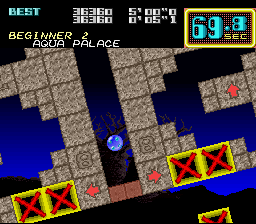
Going for a spin in Cameltry.
Camel-Try? Camel-Tree? However you pronounce it, Taito’s spinning labyrinth game is a keeper. Best described as a smoother, more exciting version of the bonus stages in the original Sonic the Hedgehog, Cameltry challenges you to guide a marble through a maze by turning the world around it. Holding down the fire button gives your marble added weight, letting it smash through barriers, but it also increases the risk that you’ll touch the penalty squares that leech away what little time you have to reach the goal. Finish a stage and you’ll be rewarded with another, more difficult one. Run out of time and you’ll be picking up what’s left of your marble with a dustbuster.

Cameltry made its debut in arcades, but there’s also an excellent Super NES conversion called On the Ball which makes the most of that system’s hardware scaling and rotation. They both play beautifully with a homemade spinner, and both come highly recommended even if you don't have a dial handy.

OMEGA RACE

It's just you and me now, triangular paddleboat!
This was always a childhood favorite on the VIC-20, and I’m still amazed at how well the (shoestring) budget computer was able to reproduce the game’s vector graphics. Nevertheless, the visuals are a lot sharper in the arcade version of Omega Race… to say nothing of its teeth! While the fearsome death ship mindlessly bounced around the playfield in the VIC-20 version of the game, it purposefully zeroes in on you here, spraying laser beams when you fall into its line of sight.

Beyond that, the experience is largely the same, with the player darting around a rectangular track, picking off innocuous drones before they can morph into more threatening forms. Omega Race demands a more proactive approach to hunting your targets than Asteroids, along with mastery of your ship’s sensitive thrusting. If you’re not moving, you won’t be living for long.

STAR TREK: STRATEGIC OPERATIONS SIMULATOR

It's smooth sailin' until every Klingon in the
quadrant closes in on you.
Back in the 1990s, a friend observed that Star Trek just doesn’t translate well to video games, because the series was more about exploration and interaction with diverse alien cultures than indiscriminate blasting. That’s clearly no longer the case, if the vast worlds and deep characterization of Mass Effect are any indication, but it must have been one hell of a challenge to squeeze the Enterprise into the cramped confines of an arcade cabinet back in 1982.

Sega’s solution was to present its game as a battle simulation. They stripped away the technobabble, the moral dilemmas, and the absurd plot twists, and presented the player with three simple goals: blast Klingons, defend space stations, and stay alive. Normally, they could achieve this with impulse power and phaser fire, but in times of distress, players could fire a photon torpedo, wiping out any Klingon caught in the explosion, or hit the warp button for a fast escape.

As dumbed down as it was from the television show, Star Trek was pretty sophisticated for a 1982 arcade game, with shields acting as a health bar years before they were commonplace and windows that showed the action from multiple perspectives. It doesn’t offer the visceral, seat of the pants action of its rival Star Wars, but Star Trek is a fun game in its own right, with a slower, more measured pace better suited to fans of the franchise.

TYPHOON 2001

Sensory overload makes a comeback in Typhoon 2001.
(Image courtesy of Arcade-Junkies.com)
Oh baby, now that’s the stuff! There’s no question… this little gem by German programmer Thorsten Kuphaldt is the king of Tempest clones. It’s closely patterned after Jeff Minter’s official remake for the Atari Jaguar, but surpasses it with the sharp high-resolution graphics only possible on a modern home computer. Best of all, it’s compatible with just about anything you can throw at it… I must have spent hours playing this on my netbook when I was going to college. But only between classes, of course! (Heh heh.)

Typhoon 2001 readily accepts mouse input, making it compatible with any spinners you happen to have on hand. It’s better if your spinner has a flywheel, but you can get by with an ordinary dial if you crank up the mouse sensitivity to adjust for the lack of inertia. You might also want to crank down the distracting Minter-brand special effects if you want to make it past the fifth stage.

VICTORY

Victory. Where figuring out what the hell
to do is half the challenge!
“Baffling” doesn’t even begin to describe this one. You’re the pilot of the Battlestar, a well-armed disco ball, and it’s your mission to keep a gang of cosmic criminals in prison. Unfortunately, you’ll be quickly swarmed by their buddies the moment the game begins. Hovercrafts streak across the sky, dropping paratroopers which free the Quarks, and clusters of ground-to-air missiles launch as you approach. If it gets too hot on the planet’s surface, you can escape to deep space for temporary relief, but the longer you’re up there, the more time the aliens have to spring the Quarks from their cells!

Like its inspiration Defender, Victory is frantic and chaotic… but it’s also incredibly confusing, something no shooter from the early 1980s should ever be. There are so many buttons and status bars and details that it’s hard to keep track of it all, and the aliens rarely give you the opportunity to sort it all out before blowing you to bits. On the plus side, your Battlesphere- er, star- controls pretty well with a dial, and there’s plenty of synthesized voice, which must have been mindblowing at the time and remains impressive thirty years later.

VS BLOCK BREAKER

Getting the boot in Vs Block Breaker.
The game emphatically states that it’s intended only for Asian audiences, and it’s easy to see why after you’ve spent a few minutes with it. With its surreal situations and a cast of bizarre, brightly colored characters spouting random phrases in Engrish, Vs Block Breaker is about as American-proof as a game can get. Some players eat up this style of game design and others couldn’t find the charm in it with an electron microscope, but they’ll both have to agree that Vs Block Breaker brings something new to the often redundant block busting genre of games.

The twist here is that each stage is a tug of war against a character on the right hand side of the screen. As time passes, your opponent squeezes your side of the playfield, giving you less room to move and shrinking your blocks. You can give yourself some temporary breathing room by hitting a power-up that sometimes drifts across the playfield, but your only hope for long-term survival is to clear away all the blocks, giving your hero the strength to squash his rival flat. It’s a clever idea that really shines in the versus mode, where two players gain and lose ground as bricks are shattered.

WOODY POP

Come on Sega, I thought we were friends!
You gotta love ‘em, but you’ve nevertheless gotta admit that Sega made a career out of lifting ideas from other companies, particularly in the 1980s, before the creation of Sonic the Hedgehog. When Nintendo gave the world Donkey Kong, Sega quickly responded with Congo Bongo. When Nintendo introduced Mario as the spokesman for its first game system, Sega gave us its own mascot, the perennially hapless Alex Kidd. And so it goes with the rather unfortunately named Woody Pop, a knock-off of Taito’s Arkanoid series.

There are differences between the two games, but they’re mostly cosmetic. While Arkanoid is set in the far reaches of ‘80s art deco space, Woody Pop takes place in a rustic 19th century mansion. While Arkanoid littered its stages with a never ending supply of spheres, cubes, and spinning cones, Woody Pop instead offers wind-up toys, belched out from question blocks strategically placed in most stages. Finally, while Arkanoid had the sleek Vaus as its lead character, Woody Pop gives you a shifty-eyed, rose-cheeked block of oak. Sega was probably aiming for adorable here, but there’s something about Woody that makes me want to run out of the room screaming.

There’s one other thing worth mentioning. Woody Pop was originally released for the Sega Master System, but it never left Japan because of its reliance on a special dial controller released only in that country. However, the game eventually did make it to the United States as an early release for the Game Gear… a handheld with no analog controls whatsoever. Uh, perhaps you should have thought that one through a bit more carefully, Sega.

Friday, June 21, 2013

The Xbox One Post-Mortem

The Xbox One as it was originally envisioned by Microsoft is no more; the victim of public outcry and the most hopelessly uphill PR battle since the debut of New Coke. Now there will be no required internet access, no daily checks to verify your rights to games, and no hassles when lending, trading, or selling software to your friends. 

All of these restrictions may be gone, but the discontent with Microsoft remains. Some gamers have been pacified by the company's decision to scuttle the Xbox One's unsavory DRM, but others are reluctant to get onboard, wary of what Microsoft once had planned for them and uncomfortable with the Kinect camera. That's still a mandatory part of the Xbox One hardware, it's still always listening for user input, and it still presents ugly possibilities for user surveillance and targeted advertising.

Microsoft is also taking heat from the minority of gamers who were happy with the machine's original design (yes, there really are some out there!), along with developers who hoped to stem the tide of used game sales. A recent article published on Gizmodo argues that Microsoft's retreat from DRM hobbles innovation and anchors the game industry to the past. However, author Kyle Wagner hangs his hat on hypotheticals... games could have been cheaper without a used market. The family sharing plan could have given up to ten people access to your games. The Xbox Live store could have emulated Steam's frequent sales and heavy discounts.

Jim Sterling, a writer for Destructoid and one of the Xbox One's most vocal critics, was not swayed by Wagner's optimistic what-if scenarios. In his response, Sterling muses: 

"It takes a lot of naivety to trust so willingly in Microsoft, a company that's done absolutely nothing to earn our trust. It takes even more to believe that an industry so dependent on heavy-handed consumer control deserves to survive. Frankly, any industry that suffers due to the reversal of ONE console's DRM policies is an industry that deserves to suffer."

Sterling has taken this hardline stance about the game industry's financial recklessness in previous Destructoid articles, and while they may sound callous, those harsh words are not without wisdom. Game development has gotten so expensive that absurd sales margins are necessary to break even on top-shelf titles. Street Fighter X Tekken is an excellent example... this crossover between two of gaming's biggest fighting franchises sold 1.4 million units, yet was still regarded as a disappointment by Capcom's sales department.

The Xbox One's internet requirement and restrictions on used games were designed to give publishers a path to meet their unrealistic sales goals. With those restrictions gone, it may be time for them to consider the reality that the game industry just can't shoulder the burden of scores of AAA titles every year. Gears of War producer Cliff Bleszinski was wrong to target used game sales for the woes of game publishers, but he's got at least one thing right... with the average game budget eclipsing any hope of a return on that massive investment, the numbers just don't work.

Returning to the topic at hand, what does Microsoft's recent policy reversal mean for the future of the Xbox One? The decision to drop DRM ensures that the Xbox One will have a future, even if it enters the console race with a few bruises and a limp. I was certain the system's internet restrictions and narrow user base would doom it to a long, dusty life on store shelves. Without those limitations, the Xbox One has an honest shot at success... but with a one hundred dollar price difference and the unnerving presence of the Kinect camera, it may have to settle for nipping at Sony's heels throughout this console cycle.

Sunday, June 16, 2013

Hola, all!

Just to let you know, I'm not dead... although a recent attempt to build a spinner for my PC did take a bite out of my thumb. I've been wanting to write a follow-up on that Ballarena article I wrote a year ago, but need the proper equipment for it. Trust me, playing an Arkanoid clone without a dial is not something you want to do.

(Neither is slicing your thumb open with an Xacto knife, but I digress.)

Anyway, I'll be back again, and hopefully soon. Thanks for your patience.