Showing posts with label reviews. Show all posts

Sunday, May 24, 2015

Alive and Kicking: More Vita Reviews


"Bring out yer dead!"
"Here's one."
"That'll be nine pence."
"I'm not dead!"
"'Ere, he says he's not dead."
"Yes he is!"
"I'm not."
"Well, he will be soon! He's very ill."
"I'm getting better!"
"I can't take him like that, it's against regulations."
"Well, can you hang around for a couple of minutes? He won't be long."
"I think I'll go for a walk..."
"You're not fooling anyone, you know!"

Contrary to what you may have heard, the Vita's not dead just yet. Read these reviews, then come back on Thursday. (Or just whack it now and put it on the cart. Whatever works.)

BORDERLANDS 2


Not a game known for its good taste.
We've already established in a past blog entry that Borderlands 2 wasn't a good fit for the Vita, but I'll be dipped if the game isn't addictive anyway. It's more focused and story-driven than the original, with your heroes struggling to thwart the plans of the gleefully psychotic corporate kingpin Handsome Jack. However, the draw of leveling up your character and arming them with increasingly powerful weapons remains. It's just good clean fun to target distant enemies with a sniper rifle that sets them ablaze, or drop a grenade that splits into a half dozen pieces, turning the surrounding area into a deadly fireworks display. (Okay, maybe the clean part doesn't apply, but it's fun, dammit!)

The Vita struggles admirably to keep up with the chaos, but occasionally fails, resulting in crashes at the worst possible moments. If the Vita freezes halfway through a lengthy mission, congratulations! You get to do it all over again! [EDIT: It's not quite that severe. The game saves your progress periodically, but if there's a crash, you'll have to wait for the minute it takes to return to the title screen.] Even when the system can keep from messing its pants, it can't match the performance of the Playstation 3 version, with a lower frame rate and enemies that burst into a resource-friendly spray of blood after they've been killed. So the Vita isn't the ideal way to play Borderlands 2, but considering its high demands and the system's limitations, it's impressive that Iron Galaxy got the game running at all.

B

LUMINES ELECTRONIC SYMPHONY


Why settle for an ordinary bonus?
Lumines was the crown jewel of the PSP launch library; the 21st century's sleeker, more urgent answer to the GameBoy pack-in Tetris. However, as time progressed, Lumines lost its grip on a fickle public. These days, the latest entry in the series can be found at used entertainment stores for as little as five dollars.

That's a shame, because Electronic Symphony is every bit as hypnotic as previous games in the series, with the added bonus of slick new special effects. Drumming the back of the Vita in time with the music will also reward you with power ups that can clear away dangerously high stacks of blocks. It's one of the rare uses of the system's back touch panel that won't make you resent the dreadful thing's existence!

The only issue with Electronic Symphony is an unfortunate constant in Lumines games. Some of the musical selections are more irritating than entrancing, particularly The Chemical Brothers' Hey Boy Hey Girl. (This is popular why, exactly?) The puzzle piece designs are also more distracting now that they're animated, but hey, there are worse things you can do with five bucks.

B

DEAD OR ALIVE 5+


You can count on it.
Since the second game on the Dreamcast, a big draw to Dead or Alive has been its intricate multi-tiered level designs. In that respect, Dead or Alive 5+ doesn't measure up to its predecessors. Sure, you'll get to tear down the walls of a rundown Chinese house and take a raft down a raging river, but there are also a lot of drab, colorless areas, including a dimly lit oil rig and a grey apartment complex in a city slum. Even the more imaginative stages have a distinct aftertaste of desperation... it's doubtful that any of DOA's fans were hoping to duke it out in the middle of a circus.

Luckily, Dead or Alive 5+ gets everything else right, and is one of the better fighting games in a library packed to the gills with them. You want the smooth, graceful action that's been a trademark of the DOA series from the very beginning? It's here. You want amazing graphics that nearly rival what you'll find in the home versions? You've got it. You want access to Virtua Fighter stars Sara, Akira, and Pai? Of course you do, and Dead or Alive 5+ gives them to you without the hassle of unlocking them in the story mode first. The only things you won't be getting are the upgrades from Dead or Alive 5 Ultimate and Dead or Alive 5 Final Round, which is only bad news if you're eager to pay for more superfluous downloadable content. If you want swimsuits, buy a copy of Sports Illustrated.

B+

GUILTY GEAR XX ACCENT CORE PLUS R


You'd need a miracle to pull me away
from Dead or Alive 5+.
Long-time readers know that I really like fighting games. Having said that, I really don't like Arc System Works fighting games. The button layouts are jumbled and counter-intuitive, there's too much emphasis on aerial combat, and battles generally devolve into tedious poke fests. When each hit only takes a couple pixels off your opponent's life bar, it takes a whole lot of them to end the match, making each battle last for what seems like an eternity. Sure, the artwork is a cut above what you'll find in other 2D fighters, but it's hard to appreciate the presentation when the meat and potatoes of the gameplay are so unpalatable.

So it goes with the latest Guilty Gear installment. Despite the superfluous subtitle (you guys lost me at "Accent"), it doesn't seem like much has changed since the fourteen year old Dreamcast game. You've got the same cast, with a handful of newbies continuing the Guilty Gear tradition of extreme weirdness, the same screaming heavy metal riffs, and even the same aspect ratio, with dark bars covering the edges of the Vita's widescreen display. I guess I didn't need all those extra pixels anyway! The bottom line is that it's business as usual for the Guilty Gear series, with little that will turn off fans or inspire detractors to give it another chance.

C+

TOUCH MY KATAMARI


They see me rollin'...
Fresh ideas in the video game industry are a rare commodity, and if they find an audience, they don't stay fresh long. Just look at Katamari Damacy, which quickly wore out its welcome after a half dozen unnecessary sequels. Touch My Katamari is the latest of these, and brings little to the experience aside from an animated King of all Cosmos and the ability to stretch your rolling ball of clutter into different shapes with the touch panel. There's not much reason to do this beyond covering more surface area, but they had to justify the title somehow!

It may just be more Katamari Damacy (and it's not even one of the better entries in the series), but there's a peculiar comfort in having this game wherever you go. It's not the first Katamari game on a handheld, but it's a more pleasant experience than Me and My Katamari thanks to the Vita's dual analog sticks and a significant reduction in load times. The PSP game would grind to a halt at certain points in your ball's growth, but on the Vita, you're free to scoop up everything from the tiniest crumbs to the tallest buildings without jarring pauses in the action. This makes annoyances like overly difficult level goals and, uh, the king's skintight gold lamé pants a little easier to swallow.

C+

ODDWORLD: STRANGER'S WRATH HD


Few games capture that wild west feel
like Stranger's Wrath.
Equal parts platformer and first-person shooter, Stranger's Wrath was a concession to the gaming trends of 2005 which refused to compromise the social commentary and warped humor that defined the Oddworld series. It's hard to notice any major enhancements to the graphics in this HD remake, but it's still fun after all these years to track down hillbilly bandits and blast 'em with lightning bugs, obnoxious squirrels, and ravenous hairballs. As the Stranger, you're given a surprising amount of strategic options in taking down outlaws... you can draw your bounties out into the open and take them alive for a hefty cash bonus, or succumb to your sadistic impulses and drop them into spinning blades and other nasty hazards. Savor the freedom you're given, because it won't last...

B+

FREEDOM WARS


Just one of many officious pricks you'll
meet in your adventure.
It's never a good sign when you return to a game out of a morbid sense of obligation rather than because you enjoy it, yet that's exactly what I found myself doing with Freedom Wars. Set in a distant future where resources are dangerously scarce (yet society can somehow build massive prisons and assign cybernetic parole officers to each inmate...), Freedom Wars forces you to repay your debt to society with a seemingly endless series of rescue missions. Step out of line, sometimes literally by taking too many steps, and your already lengthy prison sentence will be increased. The world of Freedom Wars is not a fun place to be, and generally speaking, it's not a fun game to play.


Get bent, you commie throw rug.
In all fairness- or as fair as I'm likely to be to a game that punishes you for excessive walking- Freedom Wars does offer crisp anime visuals along with a handful of promising ideas. You're armed with a thorny energy whip, and you can use it to climb walls and topple over the towering skeletal monsters holding your citizens hostage. However, there's absolutely nothing fun about gun fights with other soldiers, and Freedom Wars delights in making even the simplest tasks needlessly complicated. You'll find yourself battling with menus and the obtuse controls as often as the massive Abductors. Between the dreary fascist setting and gameplay that's challenging in all the wrong ways, just playing Freedom Wars feels like a million year prison sentence.

D+


Hey king, have you ever considered a cup?
Just sayin'...


(special thanks to IMDB for the Monty Python quotes)

Monday, January 27, 2014

Genesis DOES! (part 2)

Part two of the Genesis DOES! special is comin' at you hard and fast, with everything from sword-wielding shoguns to steel-plated sushi in the games reviewed. Hey, that's one way to get your recommended daily allowance of iron!

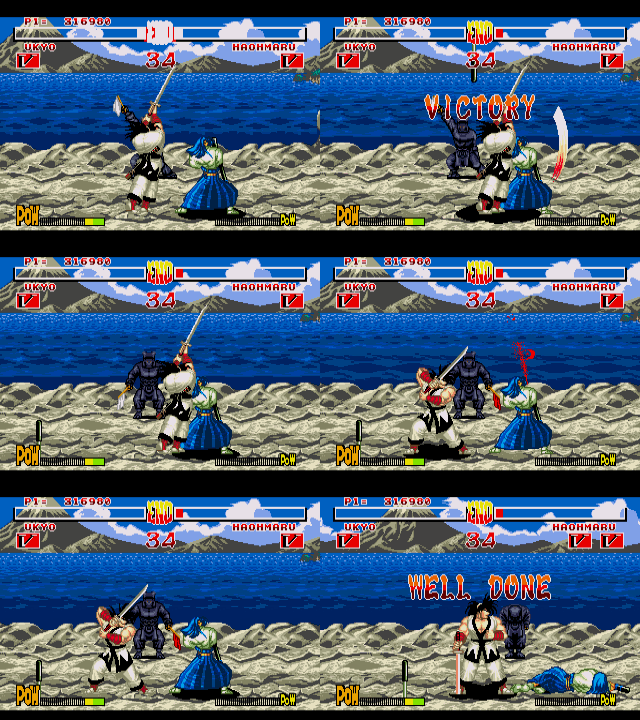
#35: SAMURAI SHODOWN

Of the three major game consoles from the early 1990s, the Genesis was most closely related to the mighty Neo-Geo, with a watered down version of its 68000 processor and Z80 sound chip. It stands to reason that the Genesis would have the best conversions of Neo-Geo games, and indeed, titles like Fatal Fury and King of the Monsters were consistently better on the Genesis than the Super NES. (We’ll not discuss that hideous port of World Heroes handled by Sega’s US division.)

This is what Genesis does that Nintendon't.
Yet even they weren’t as exciting as the originals. The Genesis was a smaller canvas than the Neo-Geo, and designers had to cut corners to make its games fit. Such is the case with Samurai Shodown, the best of the Neo-Geo conversions on Sega’s 16-bit system. In some respects it’s remarkably close to the original, but there are some features from the arcade game that the developers didn’t even try to include. Blubbery bandit Earthquake was squeezed out of the cast, leaving a gaping hole in the character select screen, and the camera is set at a fixed position, which takes away from the cinematic quality of the fights. The music is also a sorry spectacle, capturing exactly zero percent of the intensity and ancient Japanese flavor of the arcade game.

Still, the Genesis version of Samurai Shodown has just as much going for it. The characters are huge, brightly colored, and crisply drawn, and they animate just this side of beautifully, as you can see from these brief clips. The control is actually improved from the Neo-Geo original, with three dedicated buttons for both slash and kick, and the voice samples that are normally as smooth as granola on a Genesis sound remarkably clear here.

It’s no substitute for the Neo-Geo version, but Samurai Shodown is a good sight better here than it was on the Super NES, with its fights seen from three counties away and with a soundtrack performed inside a sewage drain.

#34: FIRE SHARK

Boy, do I have fond memories of this! Fire Shark was the first good game I had for the Genesis (no, Altered Beast and DJ Boy most certainly do not count). It’s an overhead view shooter, very much in the same vein as Raiden Trad, Truxton, and any one of a number of games where you frantically flail on the bomb button in times of distress. That’s not going to get you very far here, though… there’s a slight delay before the bomb explodes, forcing you to carefully time their use.

Nothing can withstand the might
of your bombs! NOTHING!
There’s one thing Fire Shark does that the millions of other shooters on the Genesis don’t… when your plane is clipped by a bullet or crashes into oncoming air traffic, you’ve got two seconds to keep firing before you go down in flames. This serves no purpose other than to give the player a false sense of hope, but it’s a nice touch. Incredibly sadistic, but nice.

Fire Shark was developed by Toaplan, a game company that’s best known for that annoying All Your Base meme but should be remembered for its excellent arcade games, including Out Zone, Snow Bros., and Alcon/Slap Fight, whose enhanced Genesis port missed this list by that much. The game was distributed in the United States by Dreamworks… not the Shrek guys, but a division of Toy Soldiers. Nobody knows for sure what Toy Soldiers was, but Sega Retro suggests the company may have been a part of Japanese publisher Nippon Computer Systems.

#33: MORTAL KOMBAT 3

I’ve always preferred Street Fighter to Mortal Kombat, and to be perfectly frank, this is not the kind of game that shines on the Genesis hardware, with its weak voice digitization and low color output. Nevertheless, Mortal Kombat 3 was as good as it got for fans of the series, if those fans couldn’t afford a Super NES.

Back when Acclaim owned the rights to the home versions of Mortal Kombat, the games were ported to Sega systems by the godawful design studio Probe, makers of such “fine” products as Back to the Future III and the disappointing GameCube conversion of Crazy Taxi. Fortunately, when series creators Williams took the reins, they threw Probe out the door and hired Sculptured Software to design the Genesis version of Mortal Kombat 3 instead.

Sculptured Software had previously created the sublime Super NES version of Mortal Kombat 2, so you knew Mortal Kombat 3 on the Genesis had to be a step up from the previous two games. It is indeed as good as the hardware would allow, with more voice, better music, and the same intense action as the arcade original. Some people balked at the addition of dial-a-combos and a run button, but these features go a long way toward speeding up the gameplay and keeping it competitive with Street Fighter II, which had shifted into turbo the year before.

There was a sequel, Ultimate Mortal Kombat 3, but you don’t want that. You’d be better off downloading the fan hack Ultimate Mortal Kombat Trilogy, which offers all the characters Sculptured Software had to trim from the supposed upgrade, plus more fatalities than you can shake a severed limb at. Most of them don’t make sense and seem cobbled together with existing sprites, but that’s Mortal Kombat for you!

One last thing: Mortal Kombat 3 uses the same typeset as the decidedly more lighthearted Waku Waku 7, released years later for the Neo-Geo. Evidently, it was a really popular font back in the 1990s.

One other last thing: both Sculptured Software and Probe were subjected to the worst torture one could inflict on a game company, being absorbed by Acclaim in the late 1990s. When the nefarious crap factory went out of business, the latter company considered starting a new design team called Exclaim, but couldn't scrape together the capital for it. (Maybe the potential investors played some of their games and ran for their lives.)

#32: DESERT STRIKE

Desert Strike, based loosely on the first war in Iraq, is one of the deepest action games you’ll find on the Sega Genesis. There are nearly a half-dozen objectives, a hundred hidden items, and countless enemies in the first mission alone!

One down... uh, two hundred
thirty six to go.
It’s also one of the toughest games you’ll ever sink your teeth into… and vice versa. After you pop this into your system, you’ll swear more before 9 AM than most gamers will all day. Success in Desert Strike (if it ever comes at all) depends not only on fast reflexes, but obsessive management of your armor, fuel, and limited supply of missiles. Run out of either of the first two and you’ll crash… run out of the latter and you’re as good as dead. Dark Souls has got nothing on this one.

Desert Strike is the first in a series of murderously difficult military themed shooters by Electronic Arts, including Jungle Strike (blow up Latin America… for America!), Urban Strike (blow up the inner city… for America!), and the advanced Saturn sequel Soviet Strike (blow up Russia… for America!). You’ll spend so much time indiscriminately blowing up people who aren’t you that you’ll wonder if you’re really one of the good guys.

The British press came to the same conclusion, angrily criticizing the storylines in the four games as “uneasily right wing,” “jingoist,” and “ugly American idiocy.” It’s a small wonder Electronic Arts didn’t respond to the criticism by releasing London Strike.

#31: SAGAIA

Taito had a Dr. Jeckyl and Mr. Hyde approach to the Sega Genesis. When it was bad, it was very,very bad, subjecting players to monstrosities like Growl, Rastan Saga, and Chase HQ II while cackling with sadistic glee. However, before the moon came out and its worst instincts were unleashed upon a hapless public, Taito crafted exceptional arcade conversions. One of their greatest gifts to mankind (or at least those members of the human race with a Genesis) was Sagaia.

Fish 'n ships.
Sagaia was the sequel to a shooter called Darius, which had two claims to fame. The first is that it’s got an aquatic theme, with steel-plated sealife serving as your enemies. The second is that the action is stretched across three screens, predating the widescreen monitors of the 21st century. This meant three times the onscreen hazards, and three times the challenge for the overwhelmed player.

Naturally, the Genesis couldn’t output to three screens at once, so Taito wisely chose to shrink down the playfield and added letterboxing to simulate an extra wide screen. It’s a fair compromise that worked much better than the later Saturn version of Sagaia, which let the player adjust their view of the action, either crushing the playfield into a tiny, distorted rectangle or leaving them without enough room to dodge bullets.

As shooters go, Sagaia isn’t the best the Genesis has to offer, but it’s a satisfyingly solid experience, with seven levels chosen from a massive pool of twenty-six, imaginative bosses, and a soundtrack that seems lifted from a Venusian game show. One highlight is Olga Breeze, the ethereal, clap-filled track that plays while you’re flying over the surface of the sun. You’ll probably want to listen to this strangely compelling piece of electronica on YouTube, because while actually playing the game, it’s often drowned out by the sound of your gunfire.


More to come!