Showing posts with label genesis. Show all posts

Saturday, February 1, 2014

Genesis DOES! (part 3)

Back in my days as a professional gaming writer, a colleague warned me that readers don't have the attention span to follow a series of articles about a single subject. With that said, here's the third part of a ridiculously long feature covering my favorite games from a long-dead game console! (What can I say, marketing was never my strong suit.)


#30: ULTIMATE QIX
Everyone’s chosen a side in the cola wars, but whether your preference is Coke, Pepsi, or even RC Cola, sometimes you want to forego the usual refreshments and try something refreshingly different. It was no different for Genesis owners… when the taste of Sonic the Hedgehog, side-scrolling beat ‘em ups, and vertically scrolling shooters weighed a little too heavily on the tongue, they reached for a tall cool glass of Ultimate Qix.
Hand grenades.
Ultimate Qix (or Volfied, if you prefer) is the 16-bit sequel to the Taito arcade game Qix, which challenged you to claim territory by drawing lines around it. As you draw, a swirling cluster of neon lines bounces around the playfield. Contact with this evil Kandinsky painting snaps your cosmic pencil in half; touching the “Sparx” racing along the lines you’ve drawn is likewise fatal.
Ultimate Qix keeps the basic gameplay of the original while enhancing the graphics and adding a few modern touches. The Qix is gone, replaced with a dozen futuristic bosses, and there are pyramids strewn throughout each stage which grant special abilities, if you’re quick enough to draw boxes around them. You’re supposed to trap the boss in a tiny portion of the screen, but if you’ve got the almighty star power up, you can end the battle of wits early and vaporize him with a deadly hail of lasers. Hey, screw the rules!
One word of caution to players eager to try this one… there’s a constant droning noise in the background of every stage. It’s supposed to add tension to the gameplay, but there’s plenty of it here without the splitting headache this noise will trigger. Get familiar with the mute button and you’ll enjoy Ultimate Qix a whole lot more.
(What’s the deal here, Taito? Was Zuntata on vacation when this game was being developed?)
#29: GAUNTLET IV

Gauntlet is an undeniable classic; the perfect marriage of twitchy arcade action and deep role-playing fantasy. It was also pretty old by 1993, which is why a straight arcade port just wasn’t going to cut it on the Sega Genesis. The system was capable of more than this, and more is exactly what you get from Gauntlet IV.
Whatever you do, don't open that door!
Gauntlet IV offers all the frantic action of the arcade game, but you knew that already. Four player action with a Sega Multi-Tap? Check. More monsters than you could count and stages than you could possibly finish? Check. A sarcastic dungeon master who reminds you to “eat your food, not shoot it?” That’s a big check.
However, there’s a lot more in store for players smart enough to snap up this title. That includes a lengthy quest mode, an arena where you can battle your friends, and the biggest plus of all, an incredible soundtrack by composer Hitoshi Sakimoto, best known for his work on Radiant Silvergun and Final Fantasy Tactics. This music, hugely reminiscent of the Conan the Barbarian film soundtrack, sets the perfect mood for slaughtering millions of monsters.
Gauntlet IV may be a little simplistic by the standards of 16-bit RPGs, but hey, you try convincing three of your friends to join you for a rousing game of Sword of Vermilion.
#28: STRIDER
Before Sonic the Hedgehog and that irritating Welcome to the Next Level marketing campaign, Sega was committed to making the Genesis the game system of choice for fans of the arcade experience. Case in point: Strider. Weighing in at a hefty eight megabits (trust me, this was a lot back in 1990) and designed by programmers on loan from Capcom, the Genesis version of Strider was the closest arcade conversion ever on a game system, until the Super NES version of Street Fighter II knocked it from its throne a couple of years later.
Screw Mario's hammer! This is the way
to deal with errant gorillas.
At its heart, Strider is a standard-issue side-scrolling action game, with futuristic ninja Hiryu charging from one end of a stage to the other, collecting power-ups and cutting down the enemies in his path with a nifty laser sword. However, it’s stylishly presented, with massive, color-soaked sprites and a breathtakingly acrobatic hero. Strider was also one of the first games with a running narrative woven into the gameplay, rather than waiting for cut scenes to tell a story. Hiryu slices his way through dozens of bizarre set pieces, including a perilous climb to the top of a power factory, a race down a hill littered with explosives, and a battle with the Soviet Politburo, whose members leap from their chairs to form a giant, scythe-wielding snake. It’s outrageous and incoherent, like a Paul Verhoeven fever dream, but just go with it!
Strider’s only problem is that it’s punishingly hard. Precise control of Hiryu’s graceful leaps and memorization of each level are an absolute must if you hope to make any progress. Worst of all, you’re only given a small handful of credits, ensuring that you’ll be playing (and swearing) for many hours before you reach the sinister Grandmaster Meio.
(By the way, is it me, or does “Grandmaster Meio” sound like a guy who raps about sandwich condiments?)

(I was recently informed by a reader- and I know, I'm surprised I have them too!- that "Grandmaster Meio" is a redundancy and that it should be either one of the other. I'll compromise and just call him "that cackling guy who's impossible to beat at the end of the game.")
#27: SPACE INVADERS ‘91
If only we had the P-Beam in 1978...
I’ll probably be hung from a yardarm by other Genesis fanatics for recommending this over Phantasy Star and Ecco the Dolphin. Let them rage, though! I was raised on fixed screen shooters, from the original Space Invaders to Megamania to the king of the genre, Galaga, and this is the best one you’ll find on the Sega Genesis.
Space Invaders ‘91’s gameplay is predictably straightforward… aliens march across the screen, dropping down and reversing direction when they hit the edges, and you pick them off before they can reach the planet you’re defending. However, there are a whole galaxy of worlds to defend in this sequel, and plenty of new aliens to blast, each with a satisfying death animation when they’re pierced with your bullets.
Equally gratifying are the hidden achievement-like bonuses (make the middle invader your first target and your shields will be fully charged), the devastating power ups you’ll earn by nailing UFOs, and a fantastic soundtrack which proves that nobody can make the Genesis sound chip sing like Zuntata. Seriously, this is really, really good music. Highlights include… everything, honestly, but the nail-biting tracks from stages five and six stand out.
It may not be up to par with its closest cousin, Galaga ‘90 on the TurboGrafx-16, but as Space Invaders games go, this is one of the best. That’s pretty high praise when you consider the excellence of later titles like Attack of the Lunar Loonies and Space Invaders Extreme.
#26: FORGOTTEN WORLDS
The bigger they are, the harder you fall.
Everyone who bought a Genesis had a reason to forsake Nintendo and join the 16-bit revolution. For some, it was the flashy (but ultimately forgettable) pack-in, Altered Beast. For others, it was Sega’s sleek new mascot, Sonic the Hedgehog. However, it was Forgotten Worlds that sold me on the system. When I first saw the game in action at a local rental store, I was mesmerized by its lush colors and eye-popping detail, which would never have been possible on the dated NES hardware. Not longer after, I sold my NES and thirteen games to the same rental store, and stepped up to the big leagues of the Sega Genesis.
With that personal anecdote out of the way, let’s talk about the game. Forgotten Worlds is a side-scrolling shooter and the follow-up to Capcom’s Side Arms. While that game was a little rigid with its robotic cast and two-way firing, Forgotten Worlds was filled to the brim with personality, with its two nameless heroes battling crowds of lizard men, possessed Egyptian barges, and goliath war gods. There are plenty of weapons available to our cosmic crusaders, and many are as impressive as they are deadly. A personal favorite is the flamethrower, which turns even the most stubborn bosses into charcoal in a matter of seconds.
At only four megabits, Forgotten Worlds isn’t a perfect conversion of the Capcom arcade game, but you’d have a hell of a time noticing the differences. Everything that matters is still here, from the omni-directional firing to the option to play with a friend. (You’re going to want to do this if at all possible; you’ll have a long, hard road ahead of you if you choose to go alone.)
Finally, Forgotten Worlds deserves credit for featuring a black guy who’s just as cool as the white one. African-American representation in video games was rare in the early 1990s, and not always flattering. Forgotten Worlds bucks this trend nicely, and believe me when I say the unappreciated African-American segment of the Genesis audience noticed.
Strider Hiryu has a robot smileodon as a pet.
Like most cats, it serves little purpose,
but damn, it's a robot. Smileodon.
More to come!

Monday, January 27, 2014

Genesis DOES! (part 2)

Part two of the Genesis DOES! special is comin' at you hard and fast, with everything from sword-wielding shoguns to steel-plated sushi in the games reviewed. Hey, that's one way to get your recommended daily allowance of iron!

#35: SAMURAI SHODOWN

Of the three major game consoles from the early 1990s, the Genesis was most closely related to the mighty Neo-Geo, with a watered down version of its 68000 processor and Z80 sound chip. It stands to reason that the Genesis would have the best conversions of Neo-Geo games, and indeed, titles like Fatal Fury and King of the Monsters were consistently better on the Genesis than the Super NES. (We’ll not discuss that hideous port of World Heroes handled by Sega’s US division.)

This is what Genesis does that Nintendon't.
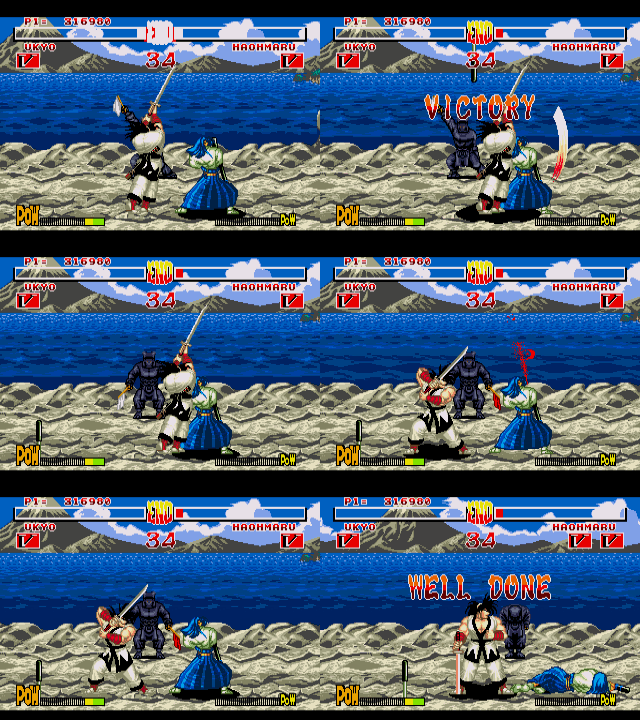
Yet even they weren’t as exciting as the originals. The Genesis was a smaller canvas than the Neo-Geo, and designers had to cut corners to make its games fit. Such is the case with Samurai Shodown, the best of the Neo-Geo conversions on Sega’s 16-bit system. In some respects it’s remarkably close to the original, but there are some features from the arcade game that the developers didn’t even try to include. Blubbery bandit Earthquake was squeezed out of the cast, leaving a gaping hole in the character select screen, and the camera is set at a fixed position, which takes away from the cinematic quality of the fights. The music is also a sorry spectacle, capturing exactly zero percent of the intensity and ancient Japanese flavor of the arcade game.

Still, the Genesis version of Samurai Shodown has just as much going for it. The characters are huge, brightly colored, and crisply drawn, and they animate just this side of beautifully, as you can see from these brief clips. The control is actually improved from the Neo-Geo original, with three dedicated buttons for both slash and kick, and the voice samples that are normally as smooth as granola on a Genesis sound remarkably clear here.

It’s no substitute for the Neo-Geo version, but Samurai Shodown is a good sight better here than it was on the Super NES, with its fights seen from three counties away and with a soundtrack performed inside a sewage drain.

#34: FIRE SHARK

Boy, do I have fond memories of this! Fire Shark was the first good game I had for the Genesis (no, Altered Beast and DJ Boy most certainly do not count). It’s an overhead view shooter, very much in the same vein as Raiden Trad, Truxton, and any one of a number of games where you frantically flail on the bomb button in times of distress. That’s not going to get you very far here, though… there’s a slight delay before the bomb explodes, forcing you to carefully time their use.

Nothing can withstand the might
of your bombs! NOTHING!
There’s one thing Fire Shark does that the millions of other shooters on the Genesis don’t… when your plane is clipped by a bullet or crashes into oncoming air traffic, you’ve got two seconds to keep firing before you go down in flames. This serves no purpose other than to give the player a false sense of hope, but it’s a nice touch. Incredibly sadistic, but nice.

Fire Shark was developed by Toaplan, a game company that’s best known for that annoying All Your Base meme but should be remembered for its excellent arcade games, including Out Zone, Snow Bros., and Alcon/Slap Fight, whose enhanced Genesis port missed this list by that much. The game was distributed in the United States by Dreamworks… not the Shrek guys, but a division of Toy Soldiers. Nobody knows for sure what Toy Soldiers was, but Sega Retro suggests the company may have been a part of Japanese publisher Nippon Computer Systems.

#33: MORTAL KOMBAT 3

I’ve always preferred Street Fighter to Mortal Kombat, and to be perfectly frank, this is not the kind of game that shines on the Genesis hardware, with its weak voice digitization and low color output. Nevertheless, Mortal Kombat 3 was as good as it got for fans of the series, if those fans couldn’t afford a Super NES.

Back when Acclaim owned the rights to the home versions of Mortal Kombat, the games were ported to Sega systems by the godawful design studio Probe, makers of such “fine” products as Back to the Future III and the disappointing GameCube conversion of Crazy Taxi. Fortunately, when series creators Williams took the reins, they threw Probe out the door and hired Sculptured Software to design the Genesis version of Mortal Kombat 3 instead.

Sculptured Software had previously created the sublime Super NES version of Mortal Kombat 2, so you knew Mortal Kombat 3 on the Genesis had to be a step up from the previous two games. It is indeed as good as the hardware would allow, with more voice, better music, and the same intense action as the arcade original. Some people balked at the addition of dial-a-combos and a run button, but these features go a long way toward speeding up the gameplay and keeping it competitive with Street Fighter II, which had shifted into turbo the year before.

There was a sequel, Ultimate Mortal Kombat 3, but you don’t want that. You’d be better off downloading the fan hack Ultimate Mortal Kombat Trilogy, which offers all the characters Sculptured Software had to trim from the supposed upgrade, plus more fatalities than you can shake a severed limb at. Most of them don’t make sense and seem cobbled together with existing sprites, but that’s Mortal Kombat for you!

One last thing: Mortal Kombat 3 uses the same typeset as the decidedly more lighthearted Waku Waku 7, released years later for the Neo-Geo. Evidently, it was a really popular font back in the 1990s.

One other last thing: both Sculptured Software and Probe were subjected to the worst torture one could inflict on a game company, being absorbed by Acclaim in the late 1990s. When the nefarious crap factory went out of business, the latter company considered starting a new design team called Exclaim, but couldn't scrape together the capital for it. (Maybe the potential investors played some of their games and ran for their lives.)

#32: DESERT STRIKE

Desert Strike, based loosely on the first war in Iraq, is one of the deepest action games you’ll find on the Sega Genesis. There are nearly a half-dozen objectives, a hundred hidden items, and countless enemies in the first mission alone!

One down... uh, two hundred
thirty six to go.
It’s also one of the toughest games you’ll ever sink your teeth into… and vice versa. After you pop this into your system, you’ll swear more before 9 AM than most gamers will all day. Success in Desert Strike (if it ever comes at all) depends not only on fast reflexes, but obsessive management of your armor, fuel, and limited supply of missiles. Run out of either of the first two and you’ll crash… run out of the latter and you’re as good as dead. Dark Souls has got nothing on this one.

Desert Strike is the first in a series of murderously difficult military themed shooters by Electronic Arts, including Jungle Strike (blow up Latin America… for America!), Urban Strike (blow up the inner city… for America!), and the advanced Saturn sequel Soviet Strike (blow up Russia… for America!). You’ll spend so much time indiscriminately blowing up people who aren’t you that you’ll wonder if you’re really one of the good guys.

The British press came to the same conclusion, angrily criticizing the storylines in the four games as “uneasily right wing,” “jingoist,” and “ugly American idiocy.” It’s a small wonder Electronic Arts didn’t respond to the criticism by releasing London Strike.

#31: SAGAIA

Taito had a Dr. Jeckyl and Mr. Hyde approach to the Sega Genesis. When it was bad, it was very,very bad, subjecting players to monstrosities like Growl, Rastan Saga, and Chase HQ II while cackling with sadistic glee. However, before the moon came out and its worst instincts were unleashed upon a hapless public, Taito crafted exceptional arcade conversions. One of their greatest gifts to mankind (or at least those members of the human race with a Genesis) was Sagaia.

Fish 'n ships.
Sagaia was the sequel to a shooter called Darius, which had two claims to fame. The first is that it’s got an aquatic theme, with steel-plated sealife serving as your enemies. The second is that the action is stretched across three screens, predating the widescreen monitors of the 21st century. This meant three times the onscreen hazards, and three times the challenge for the overwhelmed player.

Naturally, the Genesis couldn’t output to three screens at once, so Taito wisely chose to shrink down the playfield and added letterboxing to simulate an extra wide screen. It’s a fair compromise that worked much better than the later Saturn version of Sagaia, which let the player adjust their view of the action, either crushing the playfield into a tiny, distorted rectangle or leaving them without enough room to dodge bullets.

As shooters go, Sagaia isn’t the best the Genesis has to offer, but it’s a satisfyingly solid experience, with seven levels chosen from a massive pool of twenty-six, imaginative bosses, and a soundtrack that seems lifted from a Venusian game show. One highlight is Olga Breeze, the ethereal, clap-filled track that plays while you’re flying over the surface of the sun. You’ll probably want to listen to this strangely compelling piece of electronica on YouTube, because while actually playing the game, it’s often drowned out by the sound of your gunfire.


More to come!