Wednesday, August 10, 2016

You Can Build a Spinner from the Things You Find at Home

You may have noticed I was gone for a while. Here's what I was up to for the past week and some odd days. First, you'll need this musical selection to get you in the right frame of mind...


Okay, now that you've been properly Demento'ed, here's what I created while I was doing my best imitation of that other mad doctor, Victor Von whatever. You remember how paddles and dials used to be standard equipment for the really old game systems, right? Well, the industry has moved on from that style of input, but dozens of games (mostly of the "strike a ball with a paddle" variety) still play best with a spinner. Good luck actually finding one for a reasonable price, though. Your only options are to either pay through the nose for an arcade-quality dial like the Spintrak or TurboTwist, or get... creative. I chose door number two, and here's what I found behind it.


This wouldn't be the first time I've tried building a dial for Arkanoid-a-likes, but this is by far my most successful attempt. That's due in large part to the VCR head, that large silver platter crowning the plastic container. It was difficult to fish out of the dead VCR that reluctantly donated it, but it was well worth all that unscrewing. First, it's stupid cheap now that the technology is obsolete, and there's never a shortage of busted VHS players. Second, there's nothing better suited to spinning. Give it a whirl once it's anchored in place, and it'll spin for a solid seven seconds. It also responds to a delicate touch, making it perfect for catching a ball with the end of a bank tube trapped in space.
Come on, you can't tell me you weren't
thinking about Arkanoid when your
mom went through the drive-through.
(image courtesy of SafeFile.com)
You're going to need a device that can read all those twists and turns, and that's where the computer mouse comes in. Early homemade spinners used ball mouses with PS/2 connectors, but nuts to that! It's the twenty-first century, the age of optical, and you're going to want a USB cable so your modern day computer can recognize your creation.

Luckily, even optical mouses (yes, it's pluralized that way for input devices) can be found for a couple of bucks at a garage sale or thrift store. Break out a screwdriver, take the mouse apart, then put the mouse guts into an Altoids tin with a few notches strategically cut into it, as shown here on Instructables. Take off the scroll wheel and don't bother with the buttons, by the way... you won't be needing them. You want this mouse perfectly flat, or close to it.


With that done, you'll want to make a circle that attaches to the underside of your VCR head. I found that corrugated cardboard works best for this; it's light, easy to cut, and maintains its flatness. Light plastic warps, and a compact disc won't fit inside the Tupp-er, completely generic plastic container. I took the cap from a water jug, cut screw holes into it, and glued it into the center of the cardboard wheel after I cut a small hole into the center of that. 

Precision is important, and a ruler is your friend. If you're off by more than a small amount, you may get unwanted wobble, and your spinner may not work properly. Give the VCR head a few spins after you've screwed on the wheel. When you're satisfied with your work, unscrew the wheel and cut a circle into the top of the plastic container's lid with a precision knife. Make it large enough for the cap to spin freely, but not so large that the VCR head falls through. Thread the bottom of the head through the hole you've made, glue the head firmly in place with a glue gun, and reattach the cardboard wheel.


This is where things get tricky. After you cut a hole in the side of the container to thread a cable through, you're going to need to turn your mint mouse upside down so the light is facing up and shining into the cardboard wheel. The mouse has to be close enough to the wheel to trick it into believing that it's rolling on a flat surface, BUT not so close that the two rub against each other. That will keep the head from spinning freely and makes your spinner feel kind of crappy as a result.

You'll have to fill the bottom of the container just enough so that the mouse and wheel can make a love connection. Experiment with materials (I used a miniature ice cube tray and a single thin sheet of foam) and when you're happy with the way it looks, put the lid on and give your spinner a test drive on your computer. Once you've found the perfect distance between the mouse and wheel, and once the Altoids tin is lying flat, then and only then can you use the glue gun on the edges to hold everything in place.


So close you can almost taste it...
(image from EmuParadise)
Oh yeah, there's one other thing. The plastic container will be very light unless you've used wood to close the gap between the mouse and cardboard wheel. What you may want to do is add plastic feet on the bottom of the container to prevent skidding. I used thin strips of a shower sticker along the bottom of the spinner, to keep it in place. You may also want to consider gluing something heavy (rolls of pennies, used batteries, whatever) inside the container so you don't accidentally launch it off the table with frantic spinning. Distribute the weight evenly so it's balanced.

Top your spinner off with a smaller dial if you please; I used a cola cap. And that's pretty much it! The genius of this spinner's design is that it requires no soldering, no expensive parts, and no oddball drivers. If your computer could recognize your mouse before you took it apart, it'll recognize this spinner too. It's also modular, so if you make a mistake or it gets damaged in any way, you can take off the lid and fix what's broken pretty easily.

There are downsides too, of course. First, it's pretty... uh, well, it's not pretty at all, actually. If the look gets to you, you can always put it in something more presentable, like a wooden cabinet. Second, you won't have access to the three buttons on the mouse, unless you're willing to solder in a solution. The space bar on the bottom of your keyboard works pretty well as a surrogate laser in Arkanoid... just flail away and watch the bricks melt!

Oh, by the way, here are the tools and materials I used to make this spinner, since you'll probably need to know all that. You will need a precision knife for this, and you may cut yourself if you're not careful. Keep a first aid kit handy. (Also, for legal reasons, I assume no responsibility for any damage done to yourself or your property if you make this spinner.)

TOOLS:

Scissors (any sturdy pair with long blades will do)
Precision knife; ie X-Acto Size 2 blade
Glue gun
Glue sticks
Ruler (optionally, a compass for clean circles)
A pen and/or Sharpie
Phillips screwdriver (preferably a set with various sizes/bits)
Electrical tape (used to line inside of Altoids tin)
Paper (for taking notes)

MATERIALS:

VCR Head (remove from an unloved VHS player)
Sterilite 1.2 Quart container (UPC: 73149 09923)
Microsoft Wheel Mouse Optical (model: D66-00029)
Corrugated cardboard (cut from a box)
Cap from Crystal Geyser Water, 1 Gallon
Altoids tin (standard size; just find a place for the mints)
Liner for inside of Sterilite container (roughly 2.3cm deep)
Skid-proof feet (optional, but strongly recommended)
Textured cap or dial (optional)

NOTES:

Measure twice, cut once
Don't cut yourself
Take your time
Use/borrow a small drill to cut the Altoids tin if necessary
A frictionless, flat spin is crucial
Substitutions/alterations are possible but use caution
Keep first aid around just in case
Have a few of the mints; they're pretty good!
Try some of these games with your spinner
Please give credit if you use this guide elsewhere

Saturday, July 30, 2016

Re-Vita-lized

And the battle between hackers and Sony continues! There's a new exploit for the Playstation Vita and PSTV called HENKaku which not only wedges open a backdoor for homebrew apps, but makes the process incredibly easy. You go to the HENKaku web site on your system, click the orange install button, and wait a little while for the exploit to install. It may take a few tries, but it's far easier than all the hoop jumping that was necessary to hack the Vita in the past. Bravo to Yifan Lu and his team for making this happen.

So hey, July is almost over, and now that the vicious summer heat is behind me I probably ought to start updating this blog more frequently. I told the guy from VGJunk that I was going to write a guide to the multitude of weird power-ups in Capcom games (like the tiny robots, strawberries, and that pinwheel thing that's worth a kajillion points), but I never got around to it. Maybe that'll actually happen in August... provided I don't get a lot of Brainy Smurf types running in to tell me everything I missed. (It's going to be an abridged guide, for the sake of my sanity. Deal with it.)

Wednesday, July 27, 2016

So, How's 'Bout That NX?

We still don't know a lot about Nintendo's mysterious NX... but the latest rumors from Eurogamer suggest that it'll take a page from modern tablets (and those 1980s robots that combine to form even larger robots) by adapting for every situation. The system comes with two controllers, which either clip onto either side to make it an ordinary handheld game system, or can be detached for (slightly awkward) two player action. Finally, the system can slot into a docking station, making it compatible with television sets and possibly increasing its performance. The NX is supposed to use a more advanced version of the Tegra processor found in Nvidia's set top box, the Shield. However, even with that extra horsepower and even with the docking station, Nintendo's machine isn't expected to be much more powerful than the Wii U. Color me underwhelmed.
An early protoype model of the NX.
(image from Big Bad Toy Store)
Also, there's a new Layton game in the wings for the 3DS and smartphones starring Hershel's daughter. I don't really have much to say about this, but the title, Lady Layton, has stuck this earworm into my brain for the rest of the day.


(There's a Duran Duran version of this song, because someone thought that would be a good idea. Someone needs to think a little harder.)

Saturday, July 23, 2016

Genesis and Chill

There's been a strong surge in viewership lately... leaving me feeling a little guilty as I haven't posted here in over a week. So let's take care of that, shall we? I'll give you guys a reason to come back, whoever you happen to be.

So, we're seeing a lot of news from Sega over the last few days. The biggie is that there are two new Sonic games coming, which wouldn't be all that exciting if it weren't for the fact that the first is a throwback to the blue hedgehog's 16-bit days, designed by Christian Whitehead and Stealth. The former was responsible for porting Sonic CD to, well, practically every modern format imaginable, and the latter took it upon himself to make a proper port of Sonic the Hedgehog for the Game Boy Advance after Sega phoned in theirs. 

This new, yet somehow old Sonic game is called Sonic Mania, and it will be released early next year. There's also a 3D Sonic game planned for 2017, but... well... we all know how those go. Here's some footage of the game you really want, courtesy of Engadget:


Slightly less exciting is the current deal on Bundle Stars, which lets you add a fistful of Sega Genesis games to your Steam account for five dollars. I already had a few dozen of these games from past Humble Bundles, but this helps fill the gaps in my collection. Better yet, Steam Workshop lets you play "chill" versions of these games with infinite lives and energy, making nutbusters like Comix Zone and Alien Soldier slightly less impossible. You can also play games like Mega Turrican and Cool Spot that were never meant for distribution on Steam, but that's just between you and me, okay?

Last, and... er, last is the news that Sega will release another one of those heinous Sega Genesis clones to compete with Nintendo's upcoming NES Classic Mini. It will once again be manufactured by AtGames, and it once again won't be worth a damn due to off-key sound and a lack of save states. Thanks to US Gamer's Jeremy Parish for the warning... er, scoop.

Friday, July 15, 2016

Something Old, Something New, Something Borrowed, Something μ

There's no play like home! There's no play like home!
(image from Nintendo)
I guess I wouldn't be much of a nerd if I didn't mention this! Nintendo is making a bold first step into the TV Games market with a miniature version of its first console, featuring over two dozen of the best NES titles... and Ghosts 'n Goblins. Nobody knows for sure what hardware it uses or the quality of the emulation, but here's what we do know: it has an HDMI video port in the back, you can plug Wiimote peripherals into the front, and it'll cost sixty dollars.

There's one other thing... you can't add games, or remove them in the case of Ghosts 'n Goblins. But that's pretty much par for the course for a TV Games unit, isn't it? When those games include Kirby's Adventure, the Super Mario Bros. trilogy, and a wealth of third party hits including Final Fantasy, it's hard to complain about what you're not getting. Not that it will stop the internet, mind. The NES Classic Edition will be available in November, just in time for the holiday season.

In other left field Nintendo news, you can purchase Turbografx-16 games for your Wii U right now, should you be so inclined. Right now, R-Type, Bonk's Adventure, and New Adventure Island are available, and more should arrive in the near future. Galaga '88 would be nice, Nintendo! Or heck, even a port of Pac-Land that doesn't look like it was beaten half to death with an ugly stick.

Monday, July 11, 2016

Profiles in Obscurity: Vic Tokai

Sega, Nintendo, Capcom, Bethesda, Electronic Arts. They're all names that should be instantly familiar to players; towering monuments in the gaming landscape. However, for every major developer, there are at least a dozen more which struggle to find an audience. These blips on the radar tend to fade with time or blink out entirely, the victims of a rapidly changing, fiercely competitive industry. 

It's easy to forget about these companies, but they're never gone from your mind completely. Occasionally you'll think back to one of the games they published and ask yourself, "Who were these guys? Where did they come from, and what the heck happened to them?" I've often wondered this myself, which is why it seems like a really good time to debut a new feature here on Kiblitzing. From time to time, I'll dig into the history of one of these companies and share what I've found here. It's a bit like those "Where Are They Now?" features on the evening news, except this is a bit closer to "Who Are They, Now?"


(image from Giant Bomb)

VIC Tokai seems like a good place to start! This early NES publisher is probably best remembered for introducing Americans to Golgo 13, the sniper of exceptional skill and negligible personality. Seriously, I'm pretty sure this guy communicates exclusively with gun fire and ellipses.


Part Dick Tracy, part James Bond, all boring.
(image from LParchive.org)
Anyway. It may not seem that way to Americans, but VIC Tokai has been around a lot longer than the NES. Sega Retro reports that the company started in 1977 as a Japanese cable provider, and started calling itself "VIC Tokai" a year later. (If you were wondering, the "VIC" is short for "Valuable Information and Communication," or the slightly more digestible "Video Information Center.") Its parent company, Tokai, goes back even further, supplying the Japanese with natural gas since the 1950s.

VIC Tokai dipped its toe into the computer market by selling hardware in 1982 and designing business programs a year later. It wasn't until the mid 1980s that the company got involved in the video game business, teaming up with Seibu Lease to create some of its most memorable titles. (As well as some of its least. Heh.) Over time, the two companies cemented a reputation for gleefully quirky and ambitious NES titles like the aforementioned Golgo 13, Kid Kool, and Clash at Demonhead. 


Still weird as hell after all these years.
(image from Giant Bomb)
A few quick notes about the last two games. Kid Kool, a Super Mario Bros-ish side-scrolling platformer with slippery control and springy flagpoles that vaulted the player forward, became a franchise for VIC Tokai, with similar games being released for the Master System (Psycho Fox) and Sega Genesis (Decapattack). However, Clash at Demonhead is more fondly remembered in America for its odd merger of Mega Man's wide eyed, brightly colored art style and Metroid's deep, if sometimes obtuse, gameplay. To this day, the game still gets loving tributes from indie comics and popular gaming forums.


Trouble Shooter for the Sega Genesis (shown above) and its Japanese-exclusive sequel were the last VIC Tokai games with the company's distinct look and feel. After 1993, VIC Tokai stopped creating software in-house and published games for other developers, including Gremlin Interactive and Kronos Digital. It's probably not a coincidence that Kronos' miserable Criticom for the Sega Saturn and Dark Rift for the Nintendo 64 were VIC Tokai's last US releases. At the turn of the century, VIC Tokai abandoned the video game industry and devoted itself fully to cable television and the internet.

Now VIC Tokai is Tokai Communications, one of Japan's leading ISPs. Its partner from the 1980s, Seibu Lease, seems to have slipped through the cracks... information about the company is scarce, suggesting that it may either have been absorbed into Tokai or was shut down in the 1990s. However, the always handy Game Developer Research Institute has an interview with Seibu Lease employee Shouichi Yoshikawa, which sheds some light on who designed VIC Tokai's most memorable games, and where those employees went after leaving the company. 

Yoshikawa himself has retired from game development, but lectures future game designers on the tricks of the trade. So while the VIC Tokai of the 1980s is long gone, there's still hope that one of his students will bring back that style in a faithful homage. Hey, it worked for La Mulana.

(Special thanks to Encyclopedia Gamia, Sega Retro, the GDRI, and Wikipedia for providing valuable information for this article.)

Wednesday, July 6, 2016

Old Grudges Die Hard

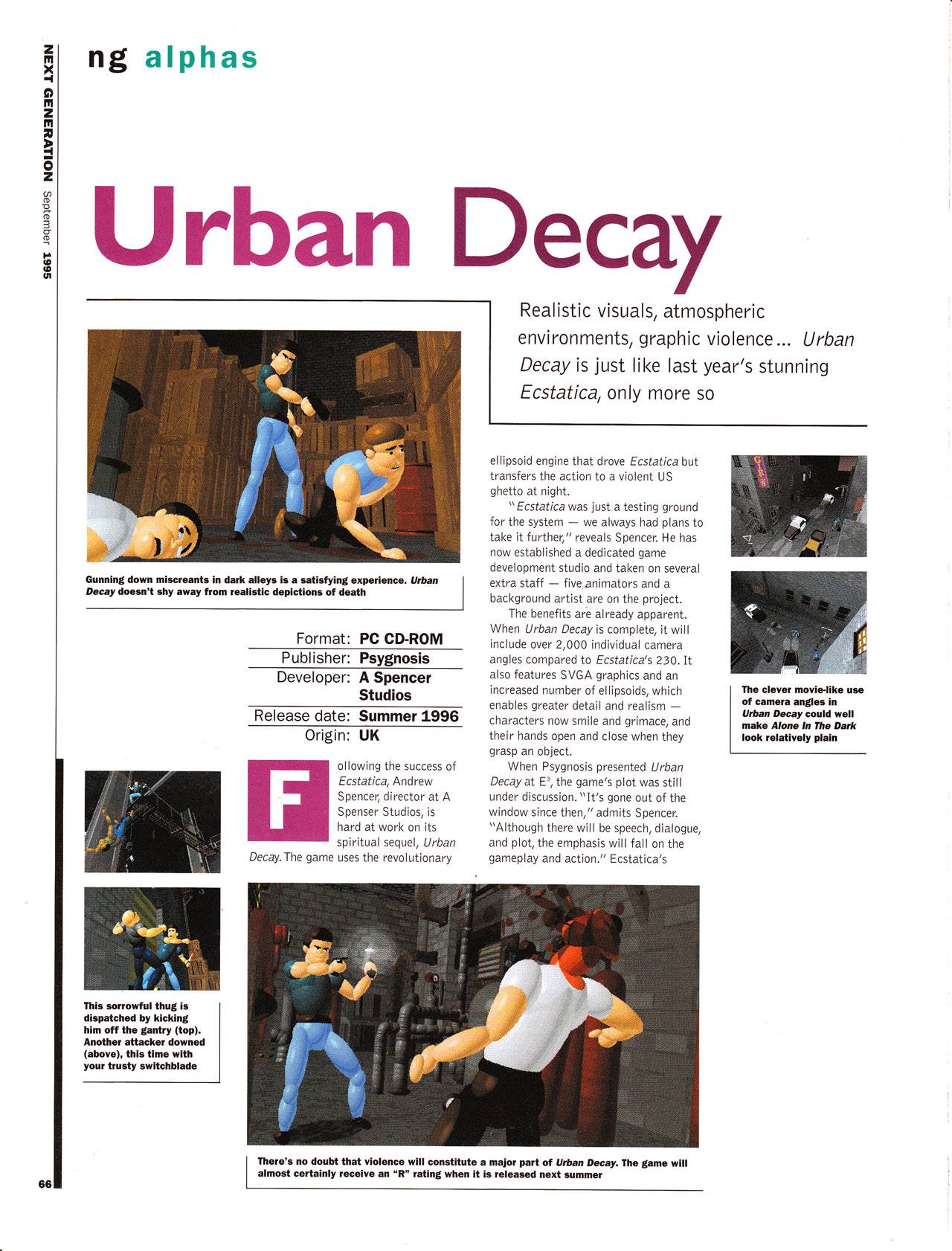
I was recently reminded of this excerpt from Next Generation magazine, posted on Hardcore Gaming 101's Twitter page a few weeks ago.


Note that Next Generation magazine was intended as an intelligent alternative to kid-friendly publications like GamePro and Nintendo Power. Note also how very far from intelligent the editors sound when they arrogantly dismiss shooter fans as "fogies" and use terms like "almost retarded" to describe the gameplay of G-Darius, regarded today as one of the high points of that series. This self-absorbed, technophilic propaganda was so common in Next Generation that one imagines the editors sniffing their own farts from wine goblets as they extol the virtues of cutting edge titles like, uh, Urban Decay.


"I didn't ASK to become the secretary of balloon
doggies! The balloon doggies DEMANDED it!"
(image from 4players.de)
I don't know where the writers of Next Generation are now... all the reviews in the magazine were written anonymously, demonstrating the foresight that the articles themselves lack. Wherever they may be, I'd like to inform them that the 2D games they worked so hard to kill have made a spectacular comeback, and cordially invite them to savor the fruit of my colon after a three course meal at the local Taco Hut.

Ah, that felt good. Speaking of Hardcore Gaming 101, I'd like to thank editor Kurt Kalata for telling me about Pharoah Rebirth+, one of the best indie games I've played in quite a while. Imagine Castlevania: Symphony of the Night, except set in Egypt and with seven stages instead of SOTN's massive playfield. And oh yeah, the hero is a rabbit with a pair of shape-shifting ears. The game was seven dollars during Steam's summer sale, but it's well worth the cost even at its usual asking price of ten. Also, it's in 2D, so it really ought to stick in the craw of whoever was writing those crap Next Generation reviews.

EDIT: It was actually HG101 contributor Federico Tiraboschi who wrote that Pharaoh Rebirth+ article, although it was technically Kurt who first told me about it. (Nice save, Jess. Heh.)